Ecommerce SEO Agency: 12 Questions to Ask Before You Sign a Retainer

SHORT ANSWER
The most useful questions to ask ecommerce SEO agency teams are the ones a general SEO seller can’t answer well. Ask how they handle filter URLs, sold out products and copied product descriptions. Ask which pages they’d fix first and who makes the changes on your platform. Then ask how they tie the work to revenue, what the retainer covers line by line, and who owns every account if you leave. And remember Google’s own line: nobody can guarantee a #1 ranking.
You’ve got three ecommerce SEO proposals open in three tabs, and they read almost the same. Technical audit. Keyword research. Content. Link building. A monthly report. The prices run from $1,800 to $6,000 a month, though, and each one wants you locked in for somewhere between three and twelve months.
The PDFs won’t tell you which agency fits your store. How they answer a few pointed questions will. So below you’ll find 12 questions, grouped in four sets of three, with what a good answer sounds like and which answers should end the call. There’s also a scorecard and a worked example showing why the cheapest proposal often isn’t.
Quick note on who’s writing. We’re GAP3, a web and digital marketing agency in Ahmedabad, India, and we pitch for ecommerce SEO work in the US and the UK. So yes, we sit on the other side of these calls. We’d still rather you asked every one of these questions. Of us too.
Shortlisting ecommerce SEO agencies right now?
Send us your store URL and platform. We reply within one business day with a fixed, itemized plan in US dollars, and you’re welcome to run all 12 questions on us.
Why an online store needs its own questions
A 30 page service website and a store with 4,000 products are different jobs. On a store, filters for size, color, price and brand can turn a few hundred category pages into hundreds of thousands of crawlable URLs. Products sell out. Variants copy each other.
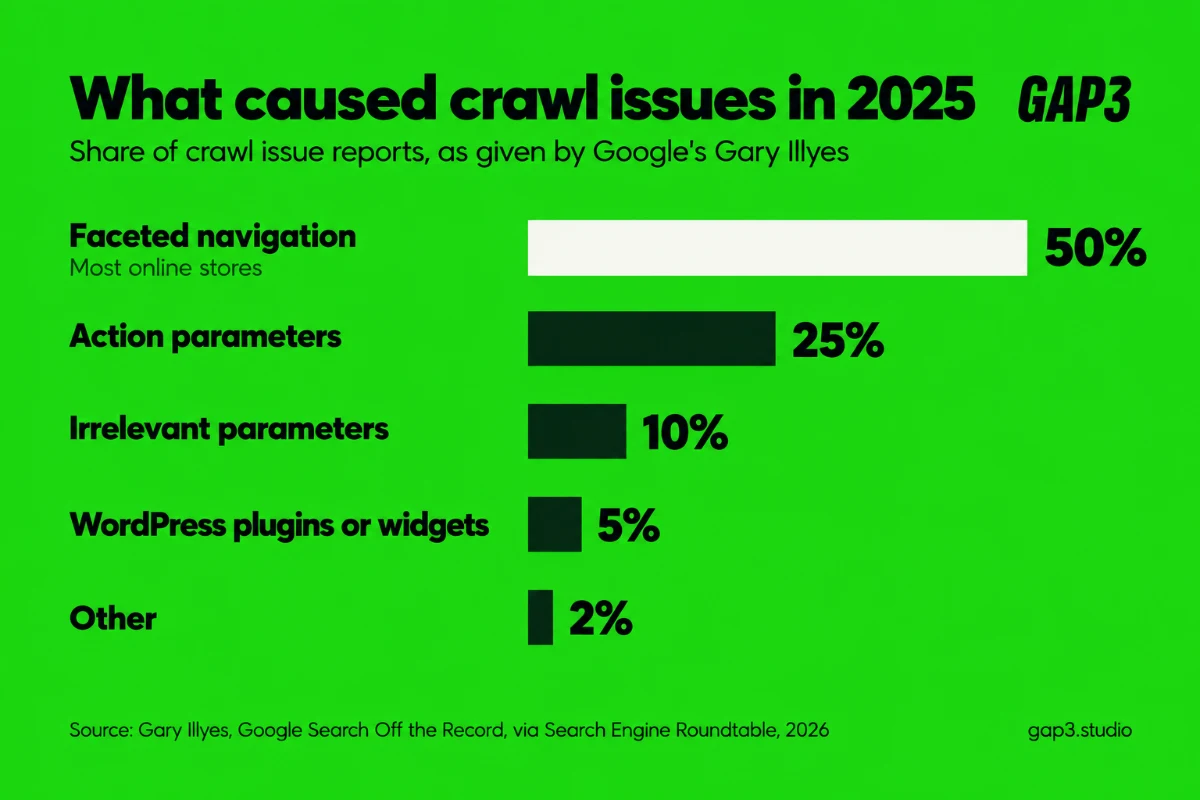
Google is pretty blunt about the filter problem. Its documentation on faceted navigation says crawlers can’t tell whether those URLs are useful without crawling them first, and that time spent on useless URLs is time not spent on new, useful ones. On Google’s Search Off the Record podcast, Gary Illyes said faceted navigation made up about 50% of the crawl issues reported to Google in 2025, as Search Engine Roundtable reported.
So an agency that only wants to talk about keywords and blog posts is quoting for the wrong job. If you only get through one set of questions on a first call, make it the first set.
Questions 1 to 3: do they understand how a store works?
1. How will you handle our filter and sort URLs?
This is the quickest filter we know. A good answer starts with crawling your store, then deciding which filter combinations deserve to be real, indexable pages (black leather boots, say, which people actually search for) and which should be blocked or kept out of the index. They should explain canonical tags, robots.txt rules and internal linking in plain words. The red flag is a blank look, or “we’ll add canonicals everywhere” and nothing more. Canonical tags on their own don’t stop Googlebot crawling millions of junk URLs.
Before the call, paste your rules into our free robots.txt tester on MyToolStudio and check a few filter URLs against them.
2. What happens to product pages when items sell out or get discontinued?
Every store deals with this. Plenty of SEO sellers have never really thought about it. The answer you want treats the two cases differently. A product that’s out of stock for a few weeks usually keeps its page, stays indexable and shows a clear back in stock option. A product that’s gone for good gets redirected to its closest replacement or its category, or returns a 404 or 410 if nothing fits. Watch out for “we just redirect everything to the homepage.” In our experience Google often treats those as soft 404s anyway, and the shopper who clicked lands somewhere useless.
3. How will you fix product copy that matches every other retailer?
If you resell brands, your descriptions probably came from the supplier feed, word for word. The agency should have a plan that doesn’t involve hand writing 3,000 pages. Start with the best sellers and the products already getting impressions. Add the stuff only you know, like fit notes, sizing quirks and the questions your support inbox gets every week. Then build templates for the long tail. A flat per page quote to “rewrite all product descriptions” with no priority order is how you end up paying for 2,000 pages nobody visits.
Questions 4 to 6: what happens in the first 90 days?
4. Which pages would you work on first, and why those?
Ask them to name actual pages from your store. The good ones will have looked before the call. On most stores they’ll point at category and collection pages first, because those match searches with real buying intent, like women’s trail running shoes, and they carry the most revenue per URL. Then the product pages for your best sellers. The blog comes later, if at all. Our guide on how to rank product and category pages explains why category pages usually win. If the pitch opens with “four blog posts a month,” they’re selling one package to everyone.
5. What can you change on our platform yourselves, and what needs our developer?
This one saves a lot of pain later. Shopify fixes some URL patterns, so products live under /products/ and categories under /collections/, though you can edit robots.txt through a theme template. WooCommerce and custom builds give you more control, and more ways to break things. If you’re still choosing, our Shopify vs WooCommerce comparison covers the SEO side.
Ask who writes the code for schema, redirects and template changes. Ask how many implementation hours the retainer includes, and whether changes go through a staging site before they hit the live store. A proposal full of recommendations with zero implementation hours means your team does the real work. Price that in.
6. What will I have in my hands at day 30, 60 and 90?
You want dates and deliverables. Something like this: by day 30, a technical audit with a ranked fix list and tracking checked. By day 60, the first fixes live and the top 20 category pages improved. By day 90, a report showing what moved and what didn’t. “SEO takes time, you’ll see results in six months” is true, and it also dodges the question. If the first audit is priced on its own, our breakdown of what a technical SEO audit should cost and include gives you something to compare against.
Questions 7 to 9: proof, people and links
7. Can you show a store you worked on, with the numbers from before you started?
“Organic revenue up 212%” tells you nothing without a starting point and a timeframe. Up 212% from $900 a month is a very different story from $90,000. Ask for a redacted Search Console report with the baseline, the platform, a rough catalog size and what the agency actually changed. Google’s own advice on hiring an SEO puts “Can you show me examples of your previous work” first on its list. Then ask to speak to one current ecommerce client.
8. Who will do the work each week, and how many other accounts do they run?
The senior person on the sales call is rarely the one rewriting your category pages. That’s fine, as long as you know who is. Get names and roles for the strategist, the technical lead and the writer. Then ask how many clients your strategist carries. Someone juggling 25 stores won’t know yours. Ask what gets subcontracted, too. Links and content are the usual ones, and you should know who’s writing about your products.
9. How do you earn links, and can I see examples?
Stores are short on links by nature. Nobody links to a product page for fun. A decent plan uses things like brand and supplier stockist pages, gift guides, digital PR built on data you hold, and reviews in real publications. Ask to see five links they built last quarter for a store. Red flags: a fixed monthly count (“20 guest posts a month”), sites that sell a post to anyone, or a refusal to show examples. Google tells site owners to avoid SEOs that talk about link popularity schemes, and says plainly that you are responsible for what the companies you hire do.
Questions 10 to 12: money, measurement and the contract
10. How will you connect the work to revenue, not rankings?
Rankings are a symptom. Ask to see a sample monthly report. You want organic revenue and orders from GA4 or your store platform, split by category, product and blog pages, plus non brand clicks from Search Console, since brand searches would have come in anyway. A good agency will also say what it can’t attribute cleanly. If the sample report is 200 keyword positions and one traffic graph, expect twelve months of exactly that.
11. What’s in the retainer, line by line, and what costs extra?
Ahrefs polled 439 SEO providers for its SEO pricing survey and found agencies charge $3,209 a month on average. Ecommerce retainers often land higher, because big catalogs and developer work take hours. To be honest, the fee matters less than what it buys. Get the scope itemized and ask what’s billed on top. Product description rewrites, developer time and tool licenses are the usual surprises.
| Line item | What to get in writing | Often billed extra? |
|---|---|---|
| Technical fixes | A ranked fix list and the hours to implement it | Yes, if the agency doesn’t touch code |
| Category and collection pages | How many get improved each month | Rarely |
| Product pages | Which products, in what order, template or hand written | Often, when priced per page |
| Content | Topics tied to buying searches, with rough lengths | Sometimes |
| Links and digital PR | Examples of past placements, not a monthly count | Often |
| Reporting and calls | Revenue, orders and non brand clicks, on a set call rhythm | Rarely |
| Tools | Which licenses the agency covers | Sometimes |
12. Who owns the accounts and the work, and how do I leave?
Everything should sit under your name. That means Google Analytics, Search Console, Merchant Center, your theme code and every page written for you. The agency gets user access, not ownership. Then read the exit terms. For SEO, a first term of three to six months with 30 days notice after that is fair. Twelve months with no exit clause, signed before anyone has touched your store, is a big ask. Ask what you get back when you leave, too: the audit, keyword map, redirect lists and change log.
All 12 questions to ask ecommerce SEO agency teams, on one page
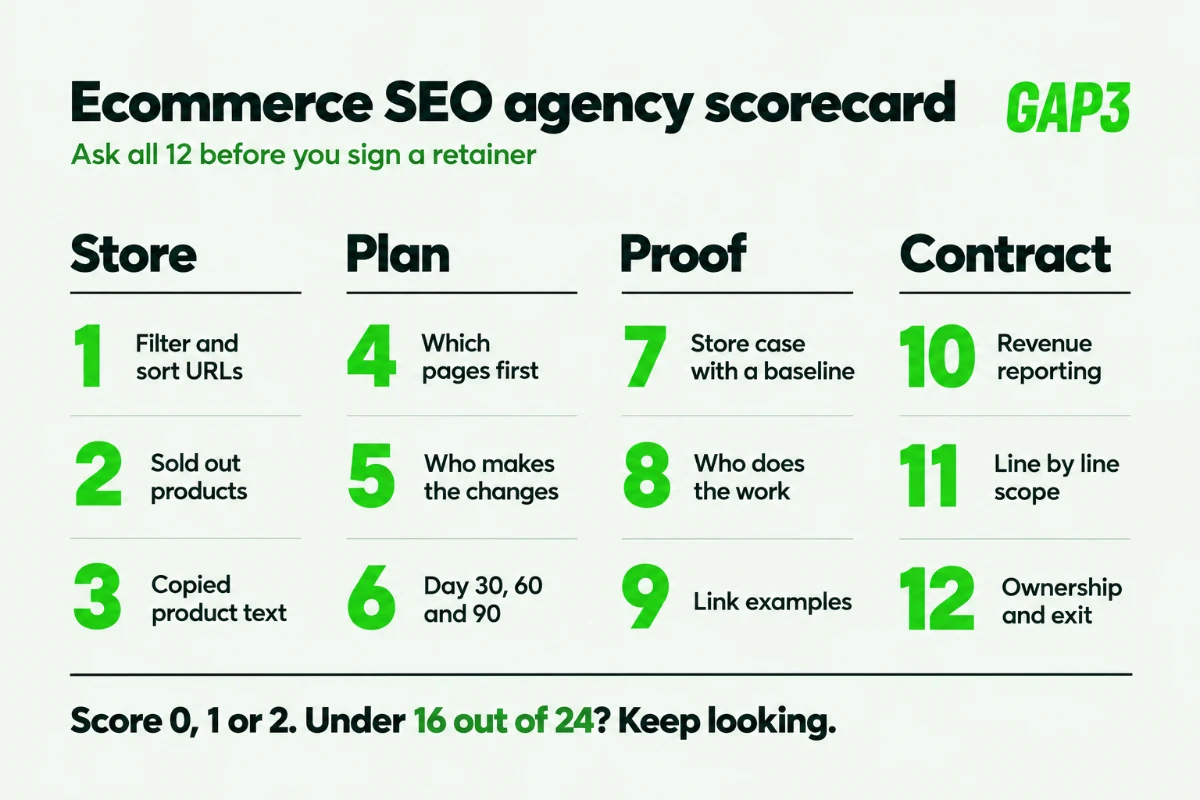
Paste this into your call notes. Score each answer 0 for a dodge, 1 for vague, 2 for specific with proof. Anything under 16 out of 24 goes to the bottom of the pile.
| # | Question | A good answer sounds like | A red flag answer |
|---|---|---|---|
| 1 | How will you handle filter and sort URLs? | Crawl first, index the filters people search, block the rest | Canonicals everywhere, nothing else |
| 2 | What happens when products sell out? | Keep temporary ones live, redirect or 404 the gone ones | Redirect it all to the homepage |
| 3 | How will you fix copied product text? | Best sellers first, your own details, templates for the rest | Flat per page rewrite of everything |
| 4 | Which pages first, and why? | Names your real category pages | Four blog posts a month |
| 5 | Who makes changes on our platform? | Set implementation hours and a staging step | We send recommendations |
| 6 | What do I have at day 30, 60, 90? | Dated deliverables | SEO takes time |
| 7 | Can I see a store with a baseline? | Before and after numbers, plus a client call | Percentages only |
| 8 | Who does the work each week? | Names, roles, account load | Our team |
| 9 | Can I see links you built? | Five recent examples | 20 guest posts a month |
| 10 | How do you tie work to revenue? | Organic revenue and non brand clicks | Keyword rankings report |
| 11 | What’s in the retainer? | Itemized scope and extras named | Ongoing optimization |
| 12 | Who owns what, and how do I leave? | You own every account, 30 days notice | 12 months, no exit clause |
Worked example: two proposals for the same store
Here’s how the questions change the math, using a made up but realistic store. It’s not a GAP3 client.
WORKED EXAMPLE: A HOME GOODS STORE ON SHOPIFY
The store does $120,000 a month. About 30% of that, $36,000, comes from organic search. Gross margin is 45% and the average order is $85.
Step 1. Agency A quotes $2,500 a month on a 12 month contract. Agency B quotes $4,000 a month for a 3 month trial, then 30 days notice.
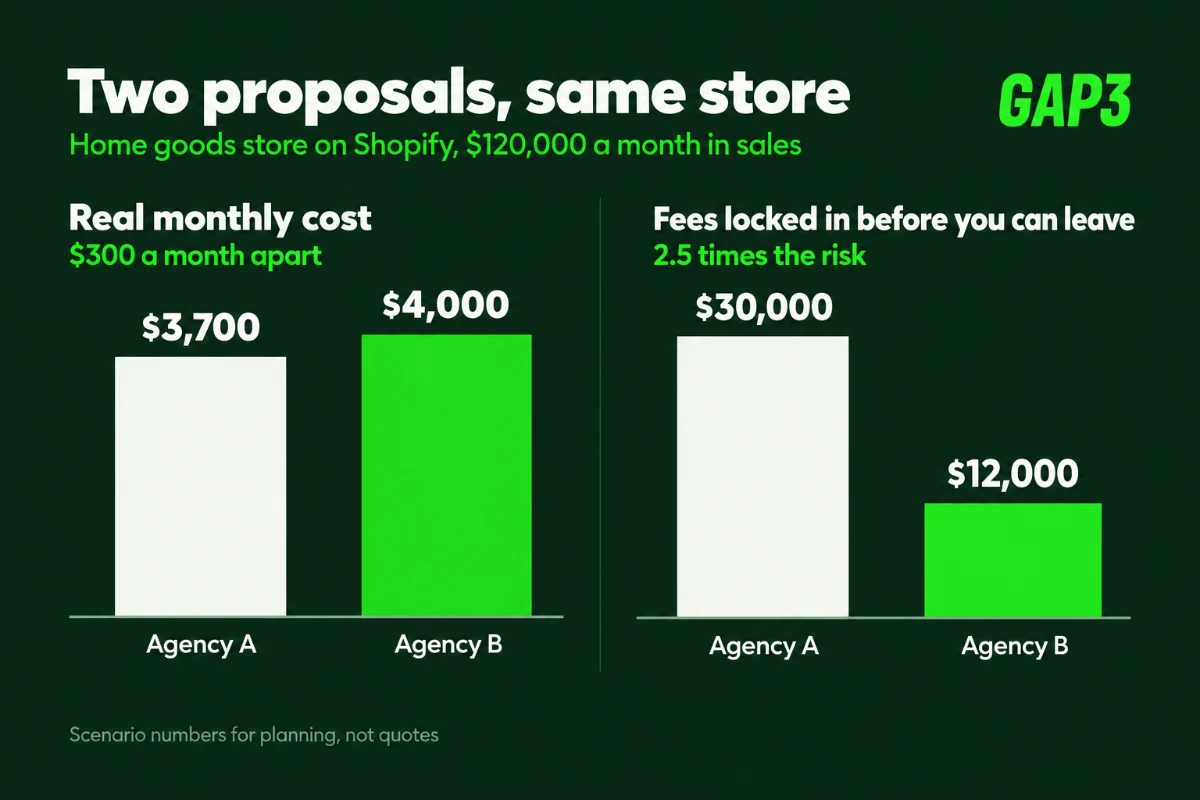
Step 2. Question 5 shows Agency A includes no implementation. Your developer needs about 16 hours a month at $75, which is $1,200. So Agency A really costs $3,700 a month.
Step 3. To break even, the extra gross profit has to cover the monthly cost. Agency A: $3,700 divided by 0.45 is about $8,222 of extra revenue, roughly 97 orders. Agency B: $4,000 divided by 0.45 is about $8,889, roughly 105 orders.
Step 4. Now the cost of picking wrong. Agency A locks in 12 times $2,500, which is $30,000 in fees. Agency B locks in 3 times $4,000, which is $12,000.
So the cheap proposal turns out to be $300 a month cheaper, and it ties up 2.5 times as much money if it doesn’t work out.
Either way, organic revenue has to grow by about a quarter (23% for A, 25% for B) before the retainer pays for itself. Inside a year, for a store with fixable problems, that’s doable. In three months it’s a stretch, which is why the trial terms matter as much as the fee.
| What to compare | Agency A | Agency B |
|---|---|---|
| Monthly fee | $2,500 | $4,000 |
| Implementation included | No, about $1,200 of developer time | Yes, up to 10 hours a month |
| Real monthly cost | $3,700 | $4,000 |
| Minimum term | 12 months | 3 months, then 30 days notice |
| Fees locked in before you can leave | $30,000 | $12,000 |
| Extra revenue needed to break even | About $8,222 a month | About $8,889 a month |
| Extra orders at $85 | About 97 | About 105 |
Want your own proposal scored against these 12 questions?
Tell us your platform, catalog size and what organic search brings in today. We’ll send a fixed, itemized ecommerce SEO plan in US dollars, with implementation hours named, within one business day.
US or offshore ecommerce SEO agency: what to ask differently
Where the agency sits changes a few questions. With an ecommerce SEO agency in the USA, time zone and market knowledge mostly come built in, and that shows up in the rate. With an offshore team, add three more questions. What hours overlap with yours? Which US or UK stores have they worked on that you can check? And what currency and law does the contract use?
We’re offshore, so here’s how we answer those. US clients are billed in dollars, and calls happen in a window that overlaps EST or PST mornings. Every project starts with a fixed, itemized quote. You see a demo every week, and the senior team that scopes the work is the same one that builds it. We’ve delivered more than 140 projects over 9 years and hold a 5.0 rating from more than 40 Google reviews. You can look through our work or see the markets we serve.
Still deciding between an agency and a hire? Our comparison of an SEO agency vs an in-house SEO team runs the numbers on both.
Red flags that should end the call
- Guaranteed rankings, or a special relationship with Google. Google’s hiring advice says no one can guarantee a #1 ranking.
- They quote without looking at your store. A blind quote is a template with your logo on it.
- The main deliverable is a fixed count of links or blog posts.
- Your Analytics, Search Console or Merchant Center would be set up under their account.
- No implementation hours, and no plan for who makes the changes.
- A 12 month term with no exit clause, plus pressure to sign this week.
- Case studies full of percentages with no starting numbers.
When you shouldn’t sign an ecommerce SEO retainer yet
Sometimes the right answer is not yet. If your store is brand new, with 20 products and no reviews, a monthly retainer mostly pays someone to wait. The U.S. Chamber of Commerce’s guide to hiring an SEO agency notes a new website can take up to a year to build authority, while one with a two year history may see results in about six months. For a launch, a one time setup project (structure, category pages, product schema, tracking) makes more sense.
Hold off, too, if a re-platform or redesign is coming. A bad migration can wipe out years of rankings in a week, so bring SEO in on the migration as a project, not a retainer. And if nobody on your side can approve changes within a week or two, an agency will spend your money waiting on sign offs.
A retainer makes sense once you have a catalog people already search for, some organic revenue to grow, and someone who can say yes. For stores in that spot, our ecommerce SEO services sit inside our wider search engine optimization work, and we’re happy to be scored on the same 12 questions.
Frequently asked questions
What questions should I ask an ecommerce SEO agency before hiring?
Start with store specific ones: filter URLs, sold out products and copied product text. Then ask which pages they’d fix first, who implements, how they report revenue, what the retainer includes and who owns the accounts if you leave.
How much does an ecommerce SEO agency cost per month?
Ahrefs’ survey of 439 SEO providers found agencies average $3,209 a month. Store retainers often run higher. Compare what each quote includes, especially implementation, not just the fee.
How long should an ecommerce SEO contract be?
A first term of three to six months, then 30 days notice, is a fair setup for most stores. A 12 month lock in with no exit clause, before any work is done, puts all the risk on you.
Can an SEO agency guarantee rankings for my store?
No. Google’s own guidance says no one can guarantee a #1 ranking. An agency can commit to deliverables and dates, so hold them to those.
Who should own my Google Analytics and Search Console accounts?
You should, always. The agency gets user access, but Analytics, Search Console and Merchant Center stay in your name, or you can lose years of data when you switch.
How long before ecommerce SEO shows results?
Deliverables should start in the first 30 days. Traffic and revenue take longer. The U.S. Chamber of Commerce notes a site with a two year history may see results in about six months, while a brand new site can take up to a year.
Is an ecommerce SEO agency in the USA better than an offshore one?
Not automatically. A US agency brings your time zone and market knowledge at a higher rate. Offshore can cost less, so ask about overlap hours, stores you can check and the contract terms.
Ready to put your shortlist to the test?
Send your store URL, platform and current organic numbers. We’ll reply within one business day with a fixed, itemized ecommerce SEO plan in US dollars, with a named team and clear exit terms.
Gaurav Gajjar is a WordPress and React developer in Ahmedabad, India, and the founder of GAP3, a digital marketing and web development agency. Since 2015 he has built custom WordPress themes, WooCommerce and Shopify stores, headless WordPress sites with React and SEO ready websites for businesses in India, the USA, the UK, Canada and Australia. He writes about WordPress development, ecommerce, technical SEO and keeping websites fast and accessible. Connect with Gaurav Gajjar on LinkedIn.