Shopify Development Cost in 2027: Store Build, Redesign and Ongoing Support

SHORT ANSWER
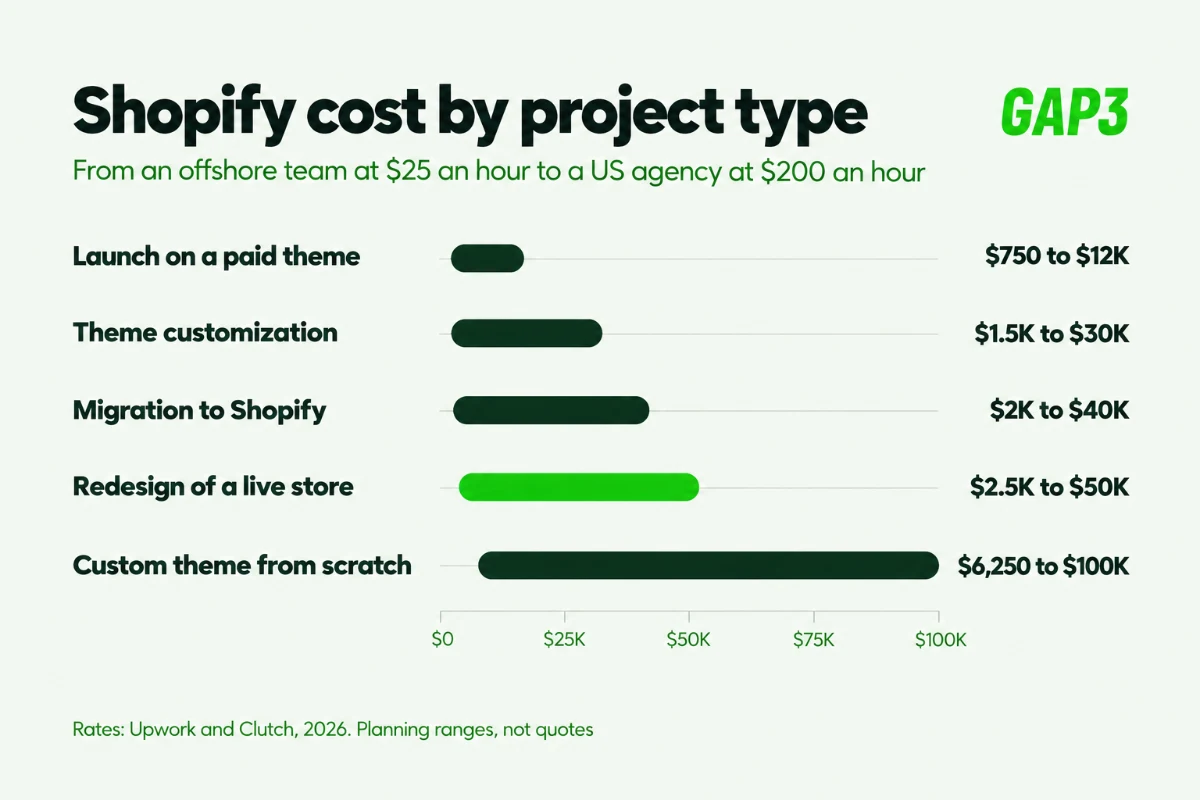
Getting a store live on a paid Shopify theme usually costs $750 to $12,000. A fully custom theme runs $6,250 to $100,000, and a redesign of a live store lands somewhere in the $2,500 to $50,000 range. Support after launch is $125 to $6,000 a month. Where you sit inside each range comes down to hours and who bills them: offshore teams at $25 to $50 an hour, or US agencies at $100 to $200. Shopify’s own plan fee, $29 to $299 a month on yearly billing, comes on top.
Ask three Shopify developers to quote the same store and you might get $2,000, $9,000 and $40,000 back. None of them is lying. They’re pricing different amounts of work, at very different hourly rates, and most quotes don’t show you either number.
That’s the problem this post tries to fix. If you came here looking for Shopify development cost 2027 numbers, you’ll get them, but broken into hours and rates so you can check any quote yourself. We cover new store builds, redesigns, monthly support and the Shopify fees that sit underneath all of it. There’s a first year budget you can copy, too.
Quick disclosure. We’re GAP3, a web and digital marketing agency in Ahmedabad, India, and we sell Shopify development services to brands in the US and elsewhere. So yes, we have a stake in this. We’ll still tell you when a freelancer, a US agency or a free theme is the smarter buy.
Have a store or a redesign in mind?
Send us your store link or your brief. We reply within one business day with a fixed, itemized estimate in US dollars.
How much does Shopify development cost in 2027? Start with the math
Here’s the thing nobody says out loud. A Shopify quote is just hours times a rate. Once you can see both, most of the mystery is gone.
Rates first. On Upwork, the typical Shopify freelancer charges $15 to $29 an hour, and the median sits at $20, per Upwork’s own Shopify developer cost guide. Clutch’s directory of US Shopify firms says most US agencies charge $100 to $200 an hour. Offshore agencies mostly quote somewhere between the two, and $25 to $50 an hour is common.
The hours below are rough ranges for typical scopes. Multiply them out and you get this.
| Project type | Typical hours | Offshore team, $25 to $50 an hour | US agency, $100 to $200 an hour |
|---|---|---|---|
| Launch on a paid theme, up to 100 products | 30 to 60 | $750 to $3,000 | $3,000 to $12,000 |
| Theme customization, custom sections, 3 to 5 apps | 60 to 150 | $1,500 to $7,500 | $6,000 to $30,000 |
| Custom theme, designed and built from scratch | 250 to 500 | $6,250 to $25,000 | $25,000 to $100,000 |
| Redesign of a live store | 100 to 250 | $2,500 to $12,500 | $10,000 to $50,000 |
| Migration from WooCommerce or another platform | 80 to 200 | $2,000 to $10,000 | $8,000 to $40,000 |
| Ongoing support, per month | 5 to 30 | $125 to $1,500 | $500 to $6,000 |
Planning ranges, not quotes. Hourly rates from Upwork and Clutch; hours are typical scopes for small and mid sized stores.
For a sanity check, Shopify’s own guide to ecommerce website costs puts custom built development at $2,000 to $20,000 or more. That matches the middle of our table. The top end climbs fast once you add custom design, big catalogs or integrations with an ERP or warehouse system.
What Shopify charges you no matter who builds the store
Some costs don’t care who your developer is. Shopify bills them directly, every month, and they belong on your budget before any development quote does.
| Shopify plan | Per month, paid yearly | Per month, paid monthly | Online card rate | Extra fee with a third party payment provider |
|---|---|---|---|---|
| Basic | $29 | $39 | 2.9% plus 30 cents | 2% |
| Grow | $79 | $105 | 2.7% plus 30 cents | 1% |
| Advanced | $299 | $399 | 2.5% plus 30 cents | 0.6% |
| Plus | From $2,300 | From $2,300 | 2.25% plus 30 cents | 0.2% |
Source: Shopify pricing page, US rates, checked September 2026.
Those figures come straight from Shopify’s pricing page. Then there’s the theme. When we checked the Shopify Theme Store in September 2026, paid themes ran from $100 to $500 as a one time purchase, with big sellers like Impulse at $500 and Prestige at $400. Free themes such as Dawn cost nothing and are honestly fine for a lot of new stores.
Apps are the cost people forget. Reviews, email, subscriptions, search and loyalty are usually separate monthly bills, and they creep up as your order count grows. Before you sign off on a build, ask your developer to list every paid app the design depends on, along with its current monthly price.
New store build: paid theme or custom theme?
This is the biggest fork in the road, and it decides whether your build is a few thousand dollars or tens of thousands.
Launching on a paid theme
Most new brands should start here. A developer installs a good theme, sets up your products, collections, payments, shipping and taxes, builds the key pages and connects your apps. That’s 30 to 60 hours for a store with up to 100 products. Our Shopify store setup work sits in this bracket.
Customizing a theme
The middle option, and in our view the best value for growing brands. You keep the theme’s tested code but add custom sections, a better product page, bundles or a quiz. Theme customization like this typically runs 60 to 150 hours, depending on how many templates change.
A fully custom theme
Here a designer draws every page from scratch and a developer codes it in Liquid. Think 250 to 500 hours, sometimes more. Nobody else will have your store. Then again, every line of that code is now yours to look after, and looking after it isn’t free. If your brand lives or dies on how the store looks, it can be worth it. For a store doing $15,000 a month, it usually isn’t.
What a Shopify redesign costs
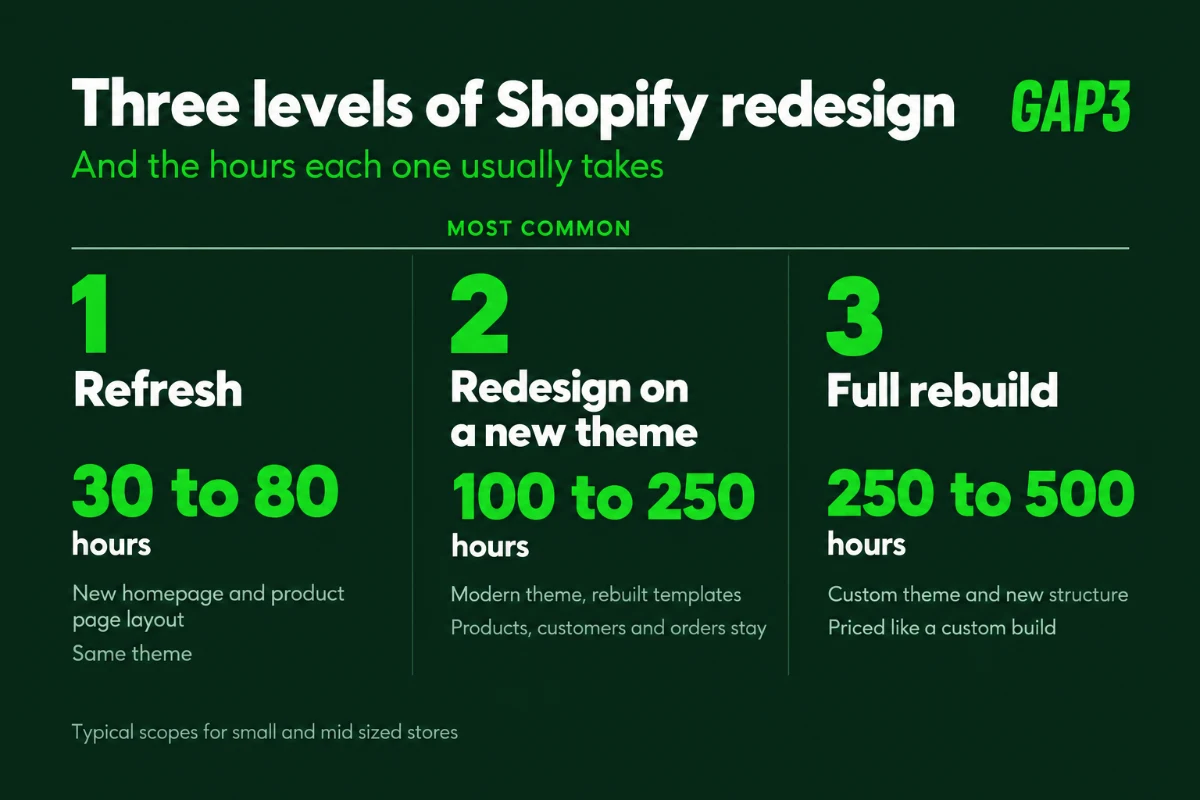
A redesign isn’t one thing. We see three levels, and they differ a lot in price.
- A refresh. New homepage, better product page layout, updated fonts and colors, same theme. Often 30 to 80 hours.
- A redesign on a new theme. You move to a modern theme, rebuild the templates and bring content across while your products, customers and orders stay put. This is the 100 to 250 hour job in the table above.
- A rebuild. A custom theme, new information architecture and new app choices. Price it like a custom build, 250 to 500 hours.
Before you pay for any of these, find out what’s actually wrong. A slow store is often an app problem rather than a design problem, and fixing it through Shopify speed optimization costs far less than a new theme. Speed does matter, though. In the Milliseconds Make Millions study Deloitte prepared for Google, a 0.1 second faster mobile site lifted retail conversions by 8.4% and average order value by 9.2%.
One more thing people get wrong. Baymard Institute puts average cart abandonment at 70.22%, and it’s tempting to blame the checkout. But Shopify’s checkout is largely standard on non Plus plans, so a redesign budget usually does more good on product pages, collection filters and mobile navigation. Our guide to Shopify conversion optimization covers where that money goes.
A cheap first step: run your store through the free site audit tool on MyToolStudio. It flags broken links, missing meta data and Core Web Vitals problems, and it gives any developer a clear starting list.
Ongoing support: what you pay each month after launch
A Shopify store doesn’t break the way a self hosted site can, since Shopify handles hosting, security and uptime. So why pay for support at all? Because your theme needs updates, apps change, promotions need landing pages, and somebody has to fix the thing that went wrong at 11pm on Black Friday.
Support is usually sold as a block of hours each month. Here’s roughly how it splits.
- Light, 5 hours a month. Theme and app updates, small content changes, a quick monthly check. Suits stores under about $20,000 a month in sales.
- Standard, 10 to 15 hours. Everything above plus campaign pages, small feature work and speed checks.
- Heavy, 20 to 30 hours. This is for stores that test things all the time, ship a new section most months and keep wiring apps into email, reviews or fulfillment.
Two questions worth asking. Do unused hours roll over? And what happens in a busy month when you blow past your block? Some teams bill the extra at a higher rate, which is fine, as long as you hear about it before the invoice.
Worked example: a first year Shopify budget for a D2C brand
Numbers make more sense with a real shaped store behind them, so here’s one.
WORKED EXAMPLE: A SKINCARE BRAND REDESIGNING ITS STORE
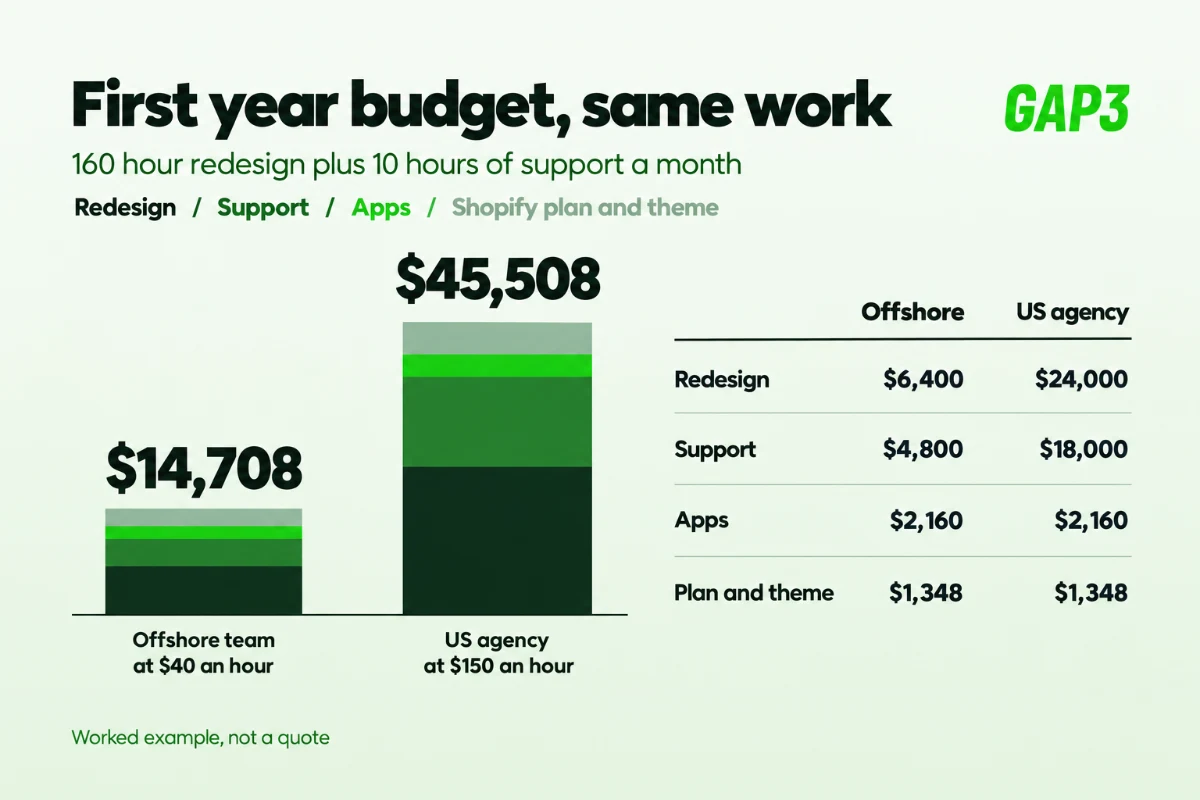
Say you sell skincare, do about $40,000 a month, and your store is on a tired theme that looks bad on phones. You want a redesign on a premium theme, then light support for the year.
Step 1. Call it 160 hours for the redesign. We’ll use $40 an hour, a fairly typical offshore number, so you’re at $6,400.
Step 2. You buy a $400 theme and stay on the Grow plan at $79 a month, paid yearly. That’s $948 for the year, so $1,348 goes to Shopify in total.
Step 3. Your apps (reviews, email, subscriptions) come to about $180 a month, or $2,160 a year.
Step 4. After launch you keep 10 hours a month of support. Same $40 rate, so that’s $400 each month and $4,800 across the year.
Add it all up and year one lands at $14,708. Now do the exact same hours with a US agency charging $150. The redesign jumps to $24,000, support to $18,000, and your year is suddenly $45,508.
Is it worth it, though? Picture your conversion rate going from 2.0% to 2.2%. Tiny, right? It’s actually a 10% lift, which on the same traffic is roughly $4,000 more in sales a month. Nobody can promise you that. But that’s the math that should decide whether you do this at all.
Payment fees are separate from all of this. At $40,000 a month with a $50 average order, you’d pay Shopify roughly $1,320 a month in card fees on Grow. That’s a cost of selling, not of development, but it belongs on the same sheet.
What pushes a Shopify quote up
When two quotes for the same brief are far apart, look for these.
- Custom design. Every page a designer creates from scratch adds design and build hours.
- Catalog size and data work. Moving 2,000 products with variants and metafields is a project of its own.
- Integrations. Connecting an ERP, a 3PL or a subscription system is where fixed quotes go to die. Get these scoped in writing.
- Migration. Coming from WooCommerce means redirects, customer data and order history. If you’re still deciding, our Shopify vs WooCommerce comparison helps.
- Markets and languages. Selling in several countries with local currencies and translated content adds testing on every template.
- Shopify Plus. Plus opens up checkout extensions and B2B features, and the work around them costs more. Read when Shopify Plus makes sense before you budget for it.
Freelancer, US agency or offshore team
We’re an offshore team, so read this knowing that. We’ll keep it straight.
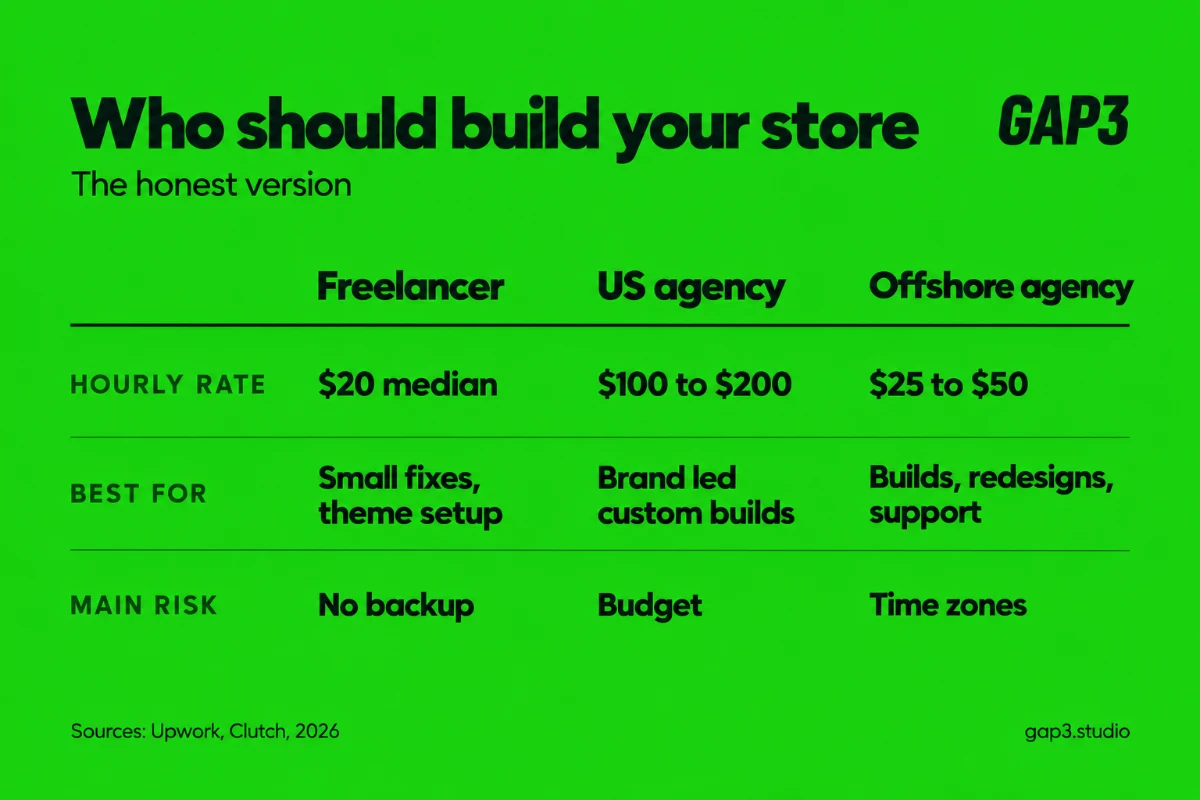
| What to compare | Freelancer | US agency | Offshore agency |
|---|---|---|---|
| Typical hourly rate | $15 to $29, median $20 (Upwork) | $100 to $200 (Clutch) | $25 to $50 is common |
| Best for | Small fixes, theme setup | Brand led custom builds, complex integrations | Builds, redesigns and monthly support |
| Main risk | One person, no backup if they vanish | Budget | Communication and time zones |
| What to check | Past Shopify stores you can click through | Who actually does the work | Overlap hours, USD billing, code ownership |
A freelancer is the right call for a small, clear job. A US agency earns its rate when you need brand strategy and design leadership in the same room, or very complex back office work. An offshore team makes the most sense for execution heavy work: builds, redesigns and steady monthly support, where the rate gap adds up quickly.
Here’s how GAP3 handles the usual offshore worries. US clients are billed in dollars, and our daily call window overlaps with EST and PST mornings. You get a fixed, itemized quote before work starts and a demo every week. The same senior team scopes and builds your project. We’ve shipped more than 140 projects over 9 years and hold a 5.0 rating from over 40 Google reviews. You can see how we work with US clients or browse our recent work.
Want your store priced line by line?
Tell us what you sell, which theme you’re on and what’s not working. You get a fixed estimate in US dollars, broken down by task, usually within one business day.
Red flags in a Shopify quote
A low quote can cost more than a high one. Watch for these.
- One total with no hours or tasks behind it. You can’t compare it to anything.
- The developer wants to own the store or the collaborator account. Your store should always be in your name.
- A custom theme pitched to a store doing a few thousand dollars a month. That’s selling, not advising.
- No mention of apps. Someone will pay for them, and it’ll be you.
- “Unlimited revisions.” It sounds generous. In practice it usually means nobody wrote down what done looks like.
- No plan for redirects on a redesign or migration. Losing old URLs can wipe out years of search traffic.
Our guide on how to hire a Shopify developer goes deeper on vetting, with the questions to ask before you pay anything.
When you shouldn’t pay for Shopify development
Sometimes the best advice is to spend nothing. If you have fewer than 50 products, you’re still testing whether people want them, and sales are a few thousand dollars a month, use a free theme and set it up yourself. Shopify’s editor is good enough. Spend the money on product photos and ads instead.
The same goes for redesigns. If your conversion rate is fine and customers aren’t complaining, a new look is a vanity project. Fix speed and the product page first. Pay for Shopify store design when the store is clearly holding the brand back, for example when mobile visitors bounce, your theme can’t do bundles, or your team fights the editor every week.
Development money pays off when you already have traffic and sales to improve. A 10% lift on $40,000 a month is real money. A 10% lift on $2,000 isn’t.
Questions we get asked a lot
How much does it cost to build a Shopify store in 2027?
If you start from a paid theme, you’re looking at roughly $750 on the cheap offshore end and up to $12,000 with a pricey US agency. Going fully custom? That’s more like $6,250 to $100,000. And don’t forget Shopify’s own fee on top, $29 to $299 a month if you pay yearly, plus whatever your apps cost.
How much does a Shopify redesign cost?
Depends which kind you mean. Freshening up the theme you have is often 30 to 80 hours of work. Moving to a new theme is bigger, usually 100 to 250 hours, so $2,500 to $12,500 with an offshore team and $10,000 to $50,000 with a US agency. Tearing it all down and rebuilding? Budget it like a custom build.
How much does Shopify maintenance cost per month?
Most people buy a monthly block of hours, anywhere from 5 to 30. Offshore, that comes to $125 to $1,500. With a US agency it’s $500 to $6,000. If your store is small, the 5 hour end is usually plenty.
How much do Shopify developers charge per hour?
It swings wildly. Upwork’s guide has the median Shopify freelancer at around $20, with most landing between $15 and $29. Hire a US agency listed on Clutch and you’ll mostly pay $100 to $200. Offshore agencies usually sit around $25 to $50.
Are Shopify themes a one time cost?
Yes. Paid themes in the Shopify Theme Store are a one time purchase, and when we checked in September 2026 they ranged from $100 to $500. Free themes such as Dawn cost nothing. Customizing a theme is a separate development cost.
Is a custom Shopify theme worth it?
For most stores under a few hundred thousand dollars a year in sales, no. A well customized premium theme gets you most of the way for a fraction of the hours. A custom theme makes sense when your brand needs something a theme truly can’t do.
Is it cheaper to hire a Shopify developer in India?
In most cases it is. You’d pay somewhere around $25 to $50 an hour instead of $100 to $200. But cheap work you have to redo isn’t cheap, so click through live stores they built, ask when they’re online during your day, and get it in writing that the code belongs to you.
How long does a Shopify build take?
A paid theme with a bit of customizing tends to go live in two to four weeks. Custom design plus apps plus a data migration is more like six to ten. Honestly, the usual hold up isn’t the developer. It’s waiting on product photos and copy from the brand side.
Get a clear number for your Shopify project
Share your store, your goals and your timeline. We send a fixed, itemized estimate in US dollars, usually within one business day, with weekly demos once work starts.
Gaurav Gajjar is a WordPress and React developer in Ahmedabad, India, and the founder of GAP3, a digital marketing and web development agency. Since 2015 he has built custom WordPress themes, WooCommerce and Shopify stores, headless WordPress sites with React and SEO ready websites for businesses in India, the USA, the UK, Canada and Australia. He writes about WordPress development, ecommerce, technical SEO and keeping websites fast and accessible. Connect with Gaurav Gajjar on LinkedIn.