
Technical SEO Audit Cost: What You Pay For and What Should Be Included


SHORT ANSWER
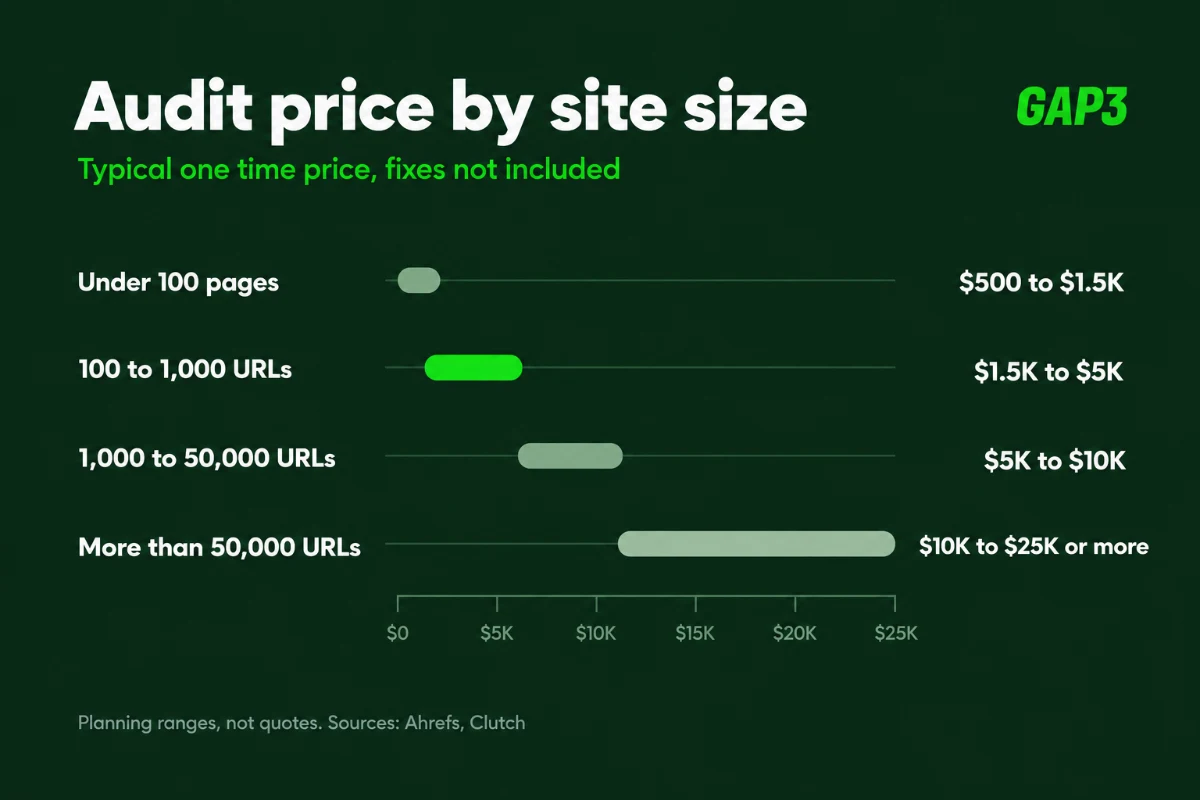
A small business site usually pays $500 to $1,500 for a proper technical audit. A mid sized B2B site or online store lands around $1,500 to $5,000, and big or JavaScript heavy sites can go past $10,000. In the Ahrefs survey of 439 SEO providers, the most common project fee was $2,501 to $5,000. Fixing what the audit finds is a separate bill, so plan for both.
Ask five SEO providers for a quote and you’ll get five very different things back. One is a $99 PDF a crawler spat out overnight. Another is a $12,000 proposal with log file analysis and a 60 page report. Both are called a technical audit. So the technical SEO audit cost is only half of what you need to know. The other half is what you actually get handed at the end.
Below we cover what US businesses tend to pay, where that money goes (mostly senior hours), a line by line list of what a proper audit should include, and the warning signs that a report won’t be worth reading. We also get into the second bill that most people forget about, which is fixing everything the audit finds.
Who is writing this? We are GAP3, a web and digital marketing agency in Ahmedabad, India, and we run technical audits for US clients. So we have a stake here. We’ll still tell you when a free tool is all you need.
Want a fixed price before you commit?
Send us your URL and your platform. We reply within one business day with a fixed, itemized quote in US dollars for the audit, with any fixes listed as separate lines.
How much does a technical SEO audit cost?
Size and complexity drive the price more than anything else. A 40 page brochure site on WordPress is a day or two of work. A store with 30,000 products, faceted filters and a JavaScript front end can take weeks, because every filter combination can turn into a URL that Google wastes time on.
The most useful public data we know of comes from Ahrefs, which surveyed 439 SEO providers about their pricing. The most common per project fee was $2,501 to $5,000, chosen by 21.2% of them. Agencies averaged $9,507.84 a project and freelancers $2,348.63. That covers every kind of SEO project, so read it as a guide and not an audit price list.
WebFX ran a smaller survey of 250 US businesses and got lower numbers. There, 43% said they paid $101 to $750 for an SEO audit. Our guess is that plenty of those were automated scans or audits bundled into a monthly plan. At that price, nobody is spending more than a few hours on your site.
Here is how we would set expectations by site type.
| Site type | Typical size | Typical audit price | Usual turnaround |
|---|---|---|---|
| Local service or brochure site | Under 100 pages | $500 to $1,500 | 3 to 5 working days |
| B2B site or small online store | 100 to 1,000 URLs | $1,500 to $5,000 | 1 to 2 weeks |
| Large store or content site | 1,000 to 50,000 URLs | $5,000 to $10,000 | 2 to 4 weeks |
| Enterprise site or JavaScript heavy app | More than 50,000 URLs | $10,000 to $25,000 or more | 4 to 6 weeks |
Planning ranges we built from the Ahrefs and Clutch pricing data and published price lists. They are not quotes.
Where the money goes: hours, seniority and tools
An audit is mostly time. Crawling a site takes an hour. Working out why 3,000 pages sit in the “Crawled, currently not indexed” report takes someone who has seen that problem before, and that person is not cheap.
Hourly rates vary a lot. Ahrefs found an average of $111 an hour, with $75 to $100 the most common band. Clutch’s SEO pricing data, drawn from 65,550 SEO companies, puts most US agencies at $100 to $149 an hour. Consultancies sit at the top. Ahrefs had them averaging $171.18 an hour.
Tools are the smaller slice. A license for Screaming Frog’s SEO Spider is $279 a year, and most teams add Ahrefs or Semrush, a rendering checker and sometimes a log file analyzer. Spread across a year of clients, the tool cost per audit is small. You are paying for judgment.
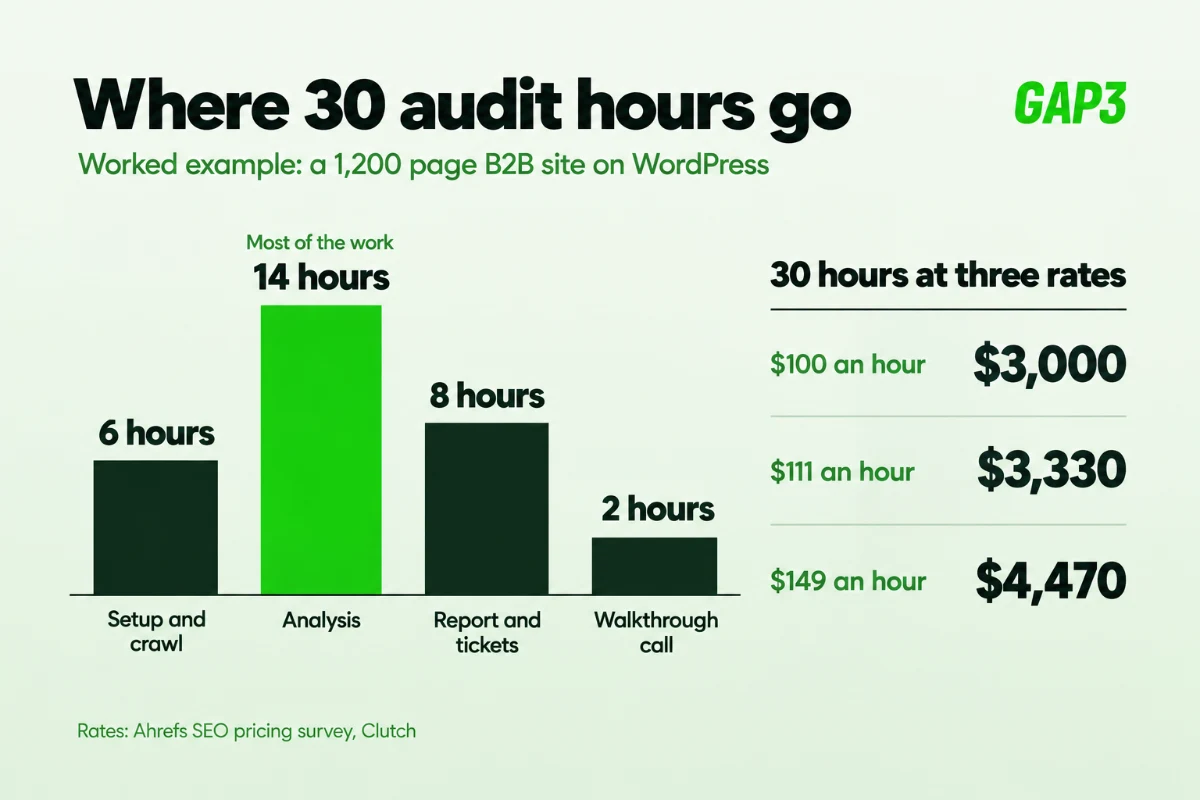
WORKED EXAMPLE: A 1,200 PAGE B2B SITE ON WORDPRESS
Picture a software company whose WordPress site has about 1,200 URLs: product pages, a blog, help docs and a handful of landing pages. Here’s how a fair audit adds up.
Step 1. Setup and crawl. Connect Search Console and analytics, then crawl the site twice, with and without JavaScript rendering. About 6 hours.
Step 2. Analysis. Indexing, canonicals, redirects, speed, internal links, schema and each page template. About 14 hours.
Step 3. Write it up as a ranked fix list plus developer tickets. About 8 hours.
Step 4. A walkthrough call with your team and follow up questions. About 2 hours.
That’s 30 hours. At the $111 Ahrefs average, you’d pay $3,330. Using Clutch’s US band of $100 to $149, it’s $3,000 to $4,470. If someone quotes $400 for this site, they’re skipping most of step 2 and all of step 3.
What a technical SEO audit should include
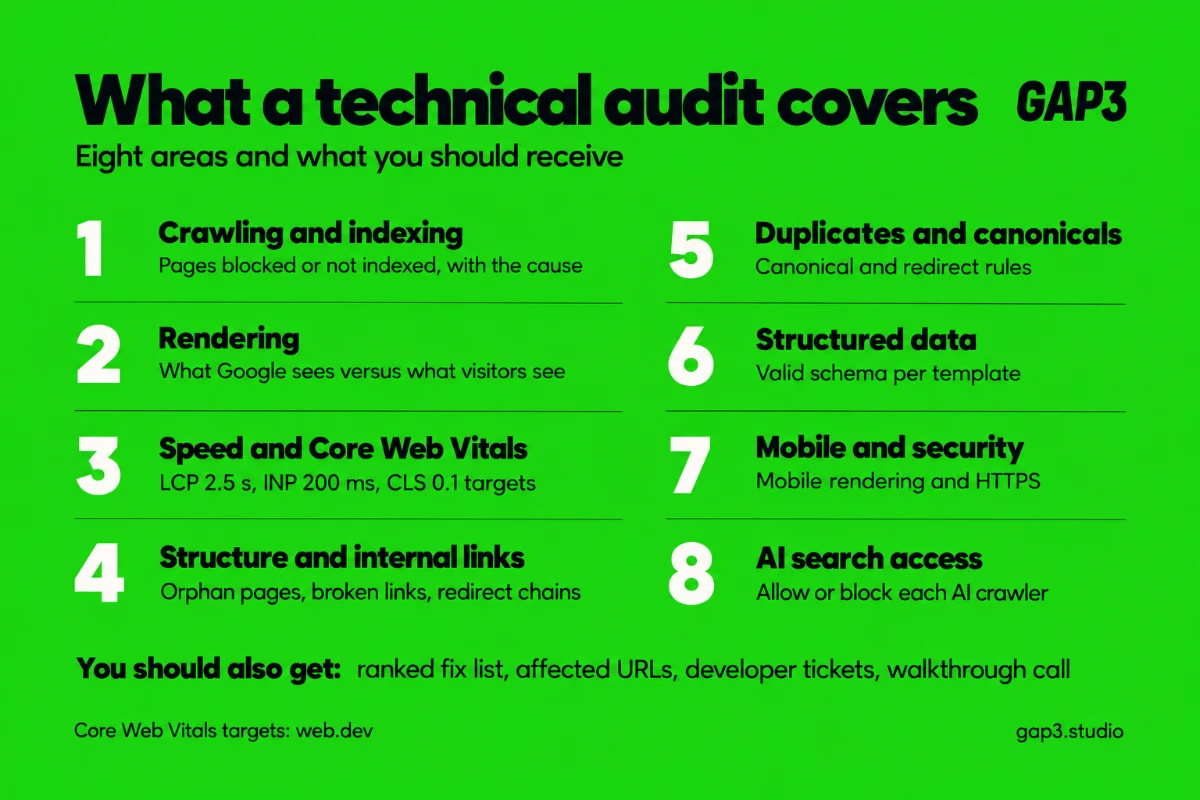
Most price guides skip this part, which is odd, because it’s the only way to compare two quotes. Below is the scope we’d expect from any serious audit, whoever runs it. If you’d rather try it yourself first, our technical SEO checklist goes through each check in plain English.
| Area | What gets checked | What you should receive |
|---|---|---|
| Crawling and indexing | robots.txt, meta robots, XML sitemaps, Search Console page indexing reports | Pages wrongly blocked or not indexed, with the cause for each group |
| Rendering | Whether Google sees the same content and links a visitor sees | Rendered versus raw HTML comparisons for your main templates |
| Speed and Core Web Vitals | LCP, INP and CLS from real user data, page weight | Fixes per template, ranked by traffic |
| Site structure and internal links | Click depth, orphan pages, broken links, redirect chains | A list of pages to link, fix or remove |
| Duplicates and canonicals | Parameter URLs, pagination, http and https versions, trailing slashes | Canonical and redirect rules a developer can apply |
| Structured data | Schema errors and missing types for your content | Valid markup examples per template |
| Mobile and security | Mobile rendering, HTTPS, mixed content | A short fix list |
| AI search access | Whether robots.txt or your firewall blocks AI crawlers you want | An allow or block decision for each crawler |
Two checks tell a careful audit apart from a quick one. The first is page weight. Google’s Googlebot documentation says it crawls the first 2MB of an HTML file, measured uncompressed, and stops there. Heavy page builders can push real content past that line, which we explained in why your website might be 2MB too big for Googlebot.
The second is real user data for speed. Google’s Core Web Vitals guidance on web.dev calls a page good at an LCP of 2.5 seconds or less, INP of 200 milliseconds or less and CLS of 0.1 or less, measured at the 75th percentile of visits. An audit that quotes one lab score from one test run is guessing. If speed turns out to be the big problem, that usually becomes its own project, like our Core Web Vitals optimization work.
Large sites need one more thing, which is server log analysis. Logs show which URLs Googlebot really requests, and it’s often not what you’d expect. On a 200 page site it’s overkill. On a store with 40,000 filter URLs, it’s where most of the useful findings come from.
What the finished report should look like
A good audit ends in a to do list. Ask for a sample report, with the client name blanked out, before you pay anything. Here’s what to look for in it.
- Every issue ranked by impact and effort, so your developer knows what to fix first.
- The affected URLs for each issue in a spreadsheet, and not three examples followed by “and many more.”
- Fixes written as tickets a developer can pick up without another meeting.
- A one page summary in plain English for whoever approves the budget.
- A walkthrough call, recorded if you can.
- A recheck after the fixes go live, or at least a clear price for one.
Page count means very little. A 90 page report made of tool screenshots is worse than a 12 page one that tells your developer exactly what to change and why.
What pushes the price up or down
Two agencies can look at the same site and come back $2,000 apart. The reason is almost always somewhere on this list.
- How many URLs exist, including ones you don’t know about. Filters, tags and internal search can turn a 500 product store into 50,000 crawlable URLs.
- Your platform. WordPress and Shopify have well known problems with well known fixes. A custom React front end or a headless build takes longer to test.
- JavaScript rendering. If content or links only show up after scripts run, the auditor has to crawl twice and compare the two.
- International setup. Hreflang across several languages or countries adds a whole extra layer of checks.
- Access. Without Search Console, analytics and server logs, the auditor works from the outside and the findings get thinner.
- Recent damage. A traffic drop after a migration or a core update needs detective work, and a checklist won’t find it.
- Implementation help. Some quotes include developer support and some stop at the report. Check which kind you’re comparing.
For online stores the filter problem alone can double the scope. That’s why ecommerce SEO audits tend to cost more than a B2B site of similar size.
The second bill: fixing what the audit finds
An audit finds problems. It doesn’t fix them. This is where budgets go sideways, because the fix list can easily cost more than the audit did.
Some fixes take five minutes, like removing a stray noindex tag. Others mean rebuilding templates. Roughly, the work splits like this.
| Type of fix | Example | Who usually does it | Rough effort |
|---|---|---|---|
| Settings and tags | Noindex left on after launch, wrong canonical, sitemap errors | SEO or site admin | Hours |
| Redirect and URL cleanup | Redirect chains, broken internal links, http to https | Developer | A day or two |
| Template changes | Title logic, schema, pagination, filter rules | Developer | One to three weeks |
| Speed work | Image handling, script loading, theme or plugin changes | Developer | One to four weeks |
| Structural changes | Site architecture, internal linking, platform migration | SEO and developer together | A month or more |
Effort ranges are our planning estimates for a small or mid sized site.
Ask for the audit and the fixes as separate lines in the quote. You should be free to hand the report to your own developer. If an agency will only sell the audit tied to a 12 month retainer, be careful, because the report may have been written to sell you that retainer.
On WordPress, speed is often the longest line on the fix list, and it’s a job of its own. That’s what WordPress speed optimization covers.
Get the audit and the fixes priced separately
We quote the audit at a fixed price and list the likely fixes as their own lines. If you hire us for the fixes too, you see progress in a weekly demo. Fixed quote. USD billing. Calls in your time zone.
Free tools, a freelancer or an agency?
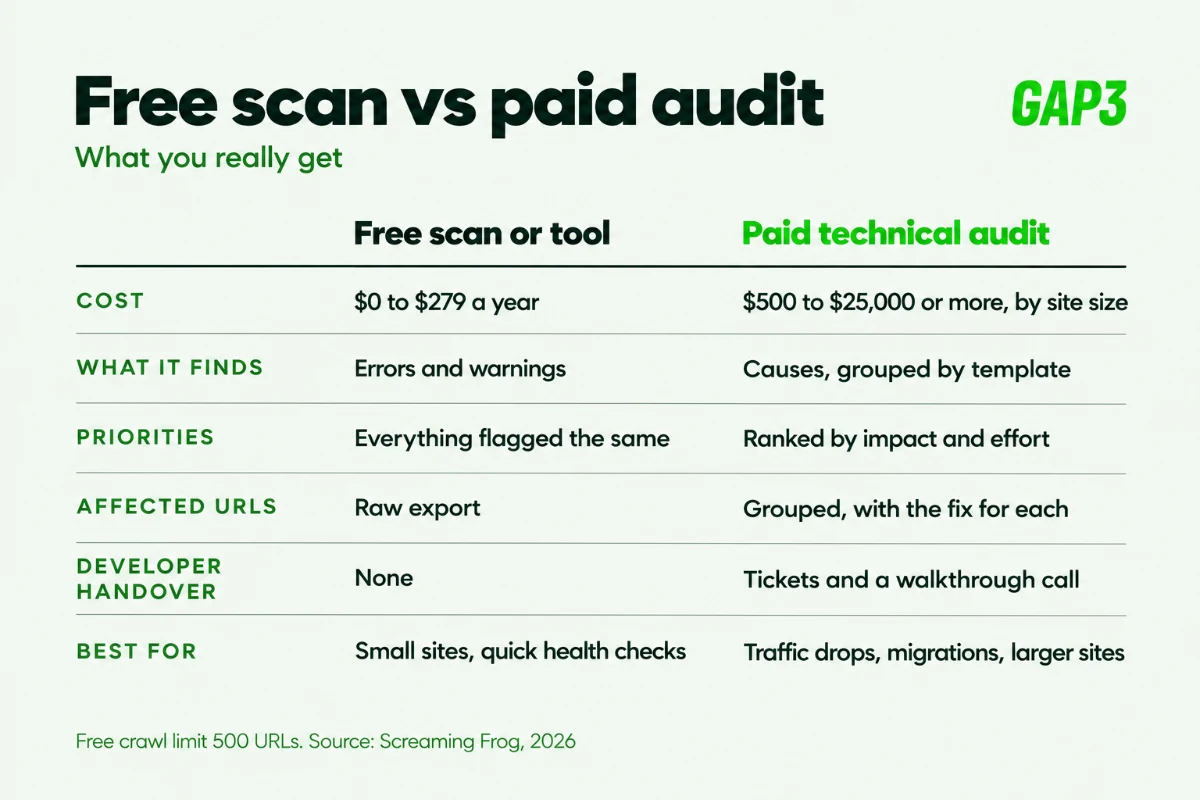
Free tools are genuinely good now. Screaming Frog’s free version crawls up to 500 URLs, which covers most small business sites. Search Console costs nothing and shows exactly which pages Google has indexed. Our own free site audit tool on MyToolStudio checks broken links, titles, schema, sitemaps and Core Web Vitals in a few minutes.
What a tool can’t do is judge. A crawler will flag 400 duplicate title warnings on your blog tag pages. A person will tell you to noindex the tag archives and move on. Most of what you pay an auditor for is knowing which 5 of 200 warnings matter.
| Option | Typical cost | Good for | Weak spot |
|---|---|---|---|
| Free tools and DIY | $0 to $279 a year | Small sites, basic health checks | No priorities or context, and you do the fixing |
| Freelancer | Ahrefs average project fee: $2,348.63 | Small and mid sized sites with a clear problem | Everything rides on one person, and developer handover can be thin |
| Agency | Ahrefs average project fee: $9,507.84 | Larger sites, audit plus fixes, teams that want a set process | Reports can get padded, so ask who actually does the work |
Freelancers can be excellent. Some of the sharpest technical SEOs we know work alone. The risk is capacity, and follow through when fixes need a developer.
US agency or offshore team for a technical audit
We’re an offshore team, so read this with that in mind. Clutch lists most US SEO firms at $100 to $149 an hour and firms in India at under $25 an hour. That’s a big gap. Technical SEO also suits offshore work well, since it’s specific, measurable and done in tools anyone can check.
Where offshore goes wrong is communication. A finding that just says “fix canonicals” helps nobody. Insist on developer ready tickets, a live walkthrough during your working hours and access to the raw crawl data.
At GAP3, US clients get a fixed, itemized quote in dollars, calls in a window that overlaps EST and PST, and a weekly demo while fixes are underway. The same senior team that scopes the audit runs it. We have delivered more than 140 projects over nine years and hold a 5.0 rating from more than 40 Google reviews. You can read how we work with US clients or browse our recent work. And if you want the fixes handled too, that’s what our technical SEO services are for.
Red flags in an audit quote
Watch for these before you pay anyone.
- A fixed price given before anyone asks how big your site is or what it runs on.
- Guaranteed rankings or traffic numbers. Nobody controls Google’s results.
- No sample report, or a sample that’s just a tool export with a logo on top.
- Findings with no affected URLs attached.
- No request for Search Console or analytics access, which means they’re auditing from the outside.
- An audit that’s free, but only if you sign a retainer.
- Every single issue marked high priority.
One of these alone isn’t fatal. Two or three together usually means you’re paying for a sales document.
When a paid audit is a waste of money
Honestly? Sometimes the right number is zero. Say your site has 30 pages, it loads fast, and Search Console shows every page indexed. A paid audit there mostly repeats what you already know. Run a free scan, fix what it flags and put the money into content or on page SEO.
Hold off if you’re about to rebuild the site, too. Auditing a site you’ll replace in three months is money down the drain. Have the new build checked before launch instead. It’s cheaper, and it catches migration mistakes while they’re still easy to fix.
And if nobody can make changes to the site right now, wait. An audit with no developer to act on it just sits in a folder. Line up the fix budget first.
So when is it worth it? After a traffic drop you can’t explain. Before and after a migration. When a big share of your pages aren’t indexed. Or once a year on a site that earns real money from search. For a wider view of what SEO and marketing cost month to month, see our guide to digital marketing agency pricing in the USA, or look at our full range of SEO services.
Frequently asked questions
How much does a technical SEO audit cost for a small business?
For a site under 100 pages, we’d expect $500 to $1,500 from someone competent. If a quote comes in at a couple of hundred bucks, it’s probably a scan with a logo slapped on it. You can get that from a free tool.
Is a technical audit different from a full SEO audit?
Yes. The technical one asks a narrow question: can Google crawl, render and index your pages, and do they load fast? A full audit piles content, keywords and backlinks on top. We’d usually do the technical side first, since there’s no point polishing content on pages Google can’t see.
How long will the audit take?
Three to five working days for a small site. Around 1,000 URLs, figure one to two weeks. Big stores and JavaScript heavy builds can run a month. Oddly, the slowest part is often just getting access to Search Console and analytics.
How often do I need one?
For most business sites, once a year does it. Add one before a redesign or platform move and another right after. If you run a big store adding products daily, a quick monthly health check between full audits is worth it.
Does the audit price include fixing the issues?
Almost never. You’re paying for the findings, the report and a call to walk through it. The fixes are a separate bill, whether your developer does them or ours. Get both on the quote as their own lines, or you can’t compare quotes fairly.
Can I audit my own site?
On a small site, sure. Screaming Frog’s free version handles 500 URLs, and Search Console tells you what Google has indexed. What’s hard is deciding which warnings actually matter. That’s the bit you pay an expert for, and it can save you weeks of chasing the wrong things.
Is a cheaper offshore audit worth it?
It can be. Just check the work before you trust it. Ask to see a sample report, make sure every finding comes with its list of URLs, and get the walkthrough booked in your own working hours. Clutch has India at under $25 an hour and the US at $100 to $149, so if the quality holds, you do save real money.
Find out what’s holding your site back
Send your URL, your platform and anything that changed recently. We reply within one business day with a fixed, itemized audit quote in US dollars and a clear list of what you’ll get.
Gaurav Gajjar is a WordPress and React developer in Ahmedabad, India, and the founder of GAP3, a digital marketing and web development agency. Since 2015 he has built custom WordPress themes, WooCommerce and Shopify stores, headless WordPress sites with React and SEO ready websites for businesses in India, the USA, the UK, Canada and Australia. He writes about WordPress development, ecommerce, technical SEO and keeping websites fast and accessible. Connect with Gaurav Gajjar on LinkedIn.