Outsource SaaS Development to India: Cost, Process, Risks, and When It Makes Sense


SHORT ANSWER
Clutch lists most Indian software firms at $25 to $49 an hour, against $50 to $99 for US firms. So on paper, you save about half. In practice we’d plan on 33% to 43% once you add a rework buffer and some US side review. A lean SaaS MVP usually lands around $30,000 to $45,000 with an Indian team. It works when you can give the project a few hours a week and own every account yourself.
Search “outsource SaaS development India” and every vendor page says the same thing. Save 60% to 80%. Round the clock progress. Top talent. Then you scroll down and it’s a contact form asking for your budget.
We think founders deserve the version with the math left in. If you’re a SaaS founder or product lead in the US or UK weighing whether to outsource SaaS development to India, this post covers what it costs by scope, the engagement models, a build process that holds up across a 10 hour time gap, the risks that actually sink projects, and the cases where you shouldn’t do it at all. Most people want a number first, so that’s where we start.
Fair warning about bias. GAP3 is a web and digital marketing agency in Ahmedabad, India, and we build SaaS products for US and UK clients. We obviously think it can work. We also know the ways it goes wrong, and that part is in here too.
Have a SaaS idea and a rough feature list?
Send it over. We reply within one business day with questions, then a fixed, itemized quote in US dollars.
How much does it cost to outsource SaaS development to India?
Start with hourly rates, because every quote is hours times rate in the end. On Clutch’s software development pricing page, updated in September 2026, the average hourly band is $25 to $49 for Indian firms and $50 to $99 for US firms. Canadian and Australian firms sit at $100 to $149. Browse the Indian developer listings on Clutch and you’ll see plenty of firms under $25 an hour as well. We’d be careful with them for SaaS work, and we’ll get to why.
Now compare that with hiring. The Bureau of Labor Statistics puts the median US software developer wage at $135,980 as of May 2025. Wages are only part of the bill. BLS employer cost data for June 2026 shows wages make up 70.0% of what private employers spend per worker, with benefits covering the other 30.0%. Divide $135,980 by 0.70 and one median developer costs about $194,257 a year, or roughly $93 for every paid hour. That’s before recruiting fees, a laptop or a single day of ramp up.
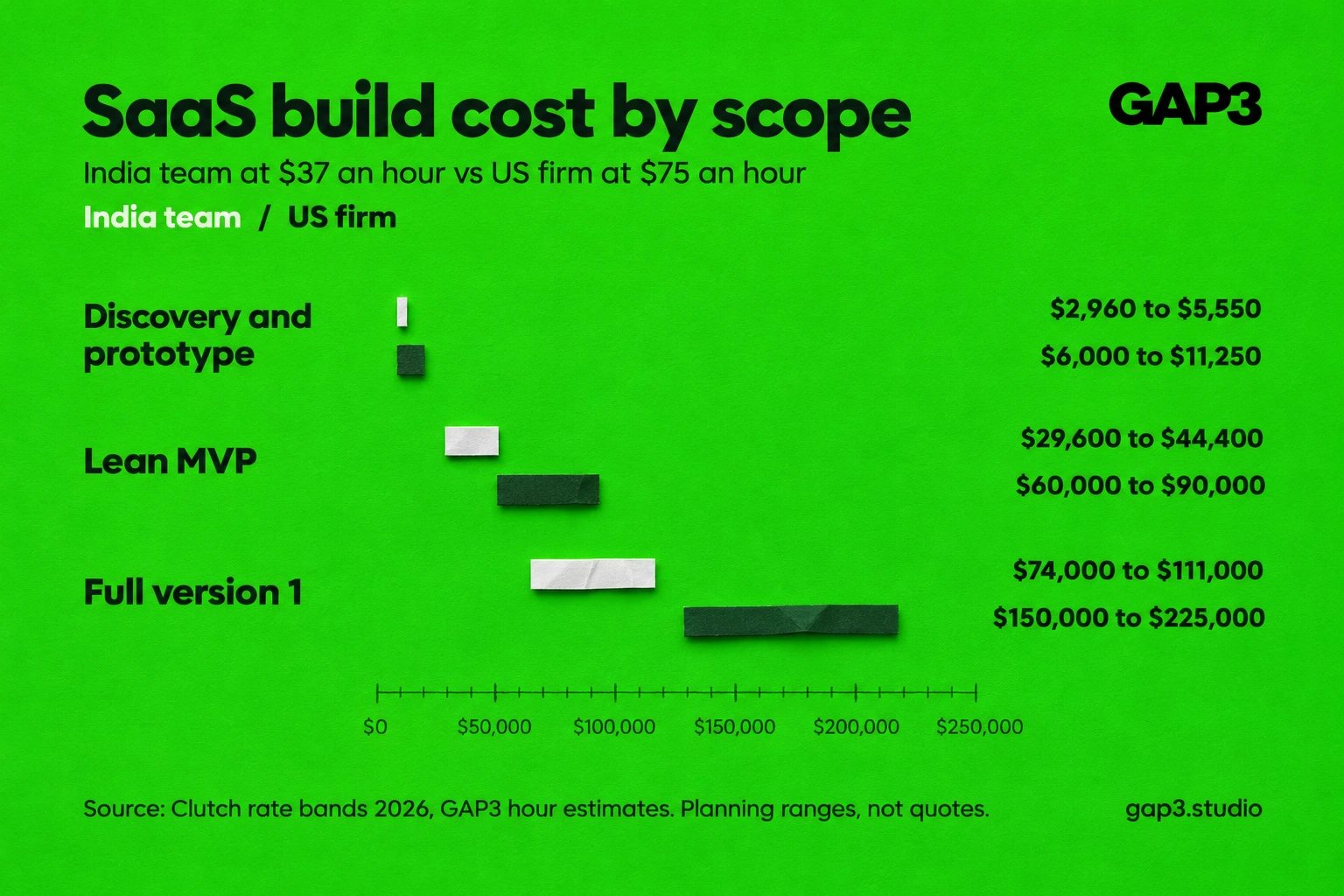
Hourly rates don’t tell a founder much on their own, though. Scope does. Here’s how the numbers look for common SaaS stages, using the midpoint of each Clutch band ($37 an hour for India, $75 rounded for the US).
| What you’re building | Typical hours | India team at $37 an hour | US firm at $75 an hour |
|---|---|---|---|
| Discovery, clickable prototype and written scope | 80 to 150 | $2,960 to $5,550 | $6,000 to $11,250 |
| Lean MVP: one user type, sign up, billing, the core workflow | 800 to 1,200 | $29,600 to $44,400 | $60,000 to $90,000 |
| Full version 1: multi tenant, roles, integrations, admin dashboard | 2,000 to 3,000 | $74,000 to $111,000 | $150,000 to $225,000 |
| Ongoing product team of three, about 480 hours a month | Monthly | $17,760 a month | $36,000 a month |
Planning ranges built from Clutch rate bands and our own hour estimates. They are not quotes. Hosting, third party APIs and app store fees are extra.
As a sanity check, Clutch says the average software project reviewed on its platform cost $132,480.29 and ran about 13 months. That’s all software, not just SaaS, but it sits right between our lean MVP and full version 1 rows at US rates, so the ranges above aren’t fantasy.
If you’re still at the idea stage, our guide to building a SaaS MVP goes deeper on what belongs in that first release and what can wait.
What you really save once the friction is priced in
Offshore work has costs that don’t show up on the rate card. Specs need to be tighter. Some things get built twice because a sentence in a ticket meant one thing in Denver and another thing in Pune. You’ll also want someone on your side who can read a pull request, even for a few hours a month. Price all of that in and the savings shrink. They don’t vanish.
WORKED EXAMPLE: A B2B SCHEDULING TOOL FOR HOME CARE AGENCIES
Picture a two founder startup in Ohio. One is a former home care operator, the other handles sales. Neither writes code. They want a scheduling and billing tool for small home care agencies. Once the feature list is written out properly, it adds up to roughly 2,000 hours of design, build and testing.
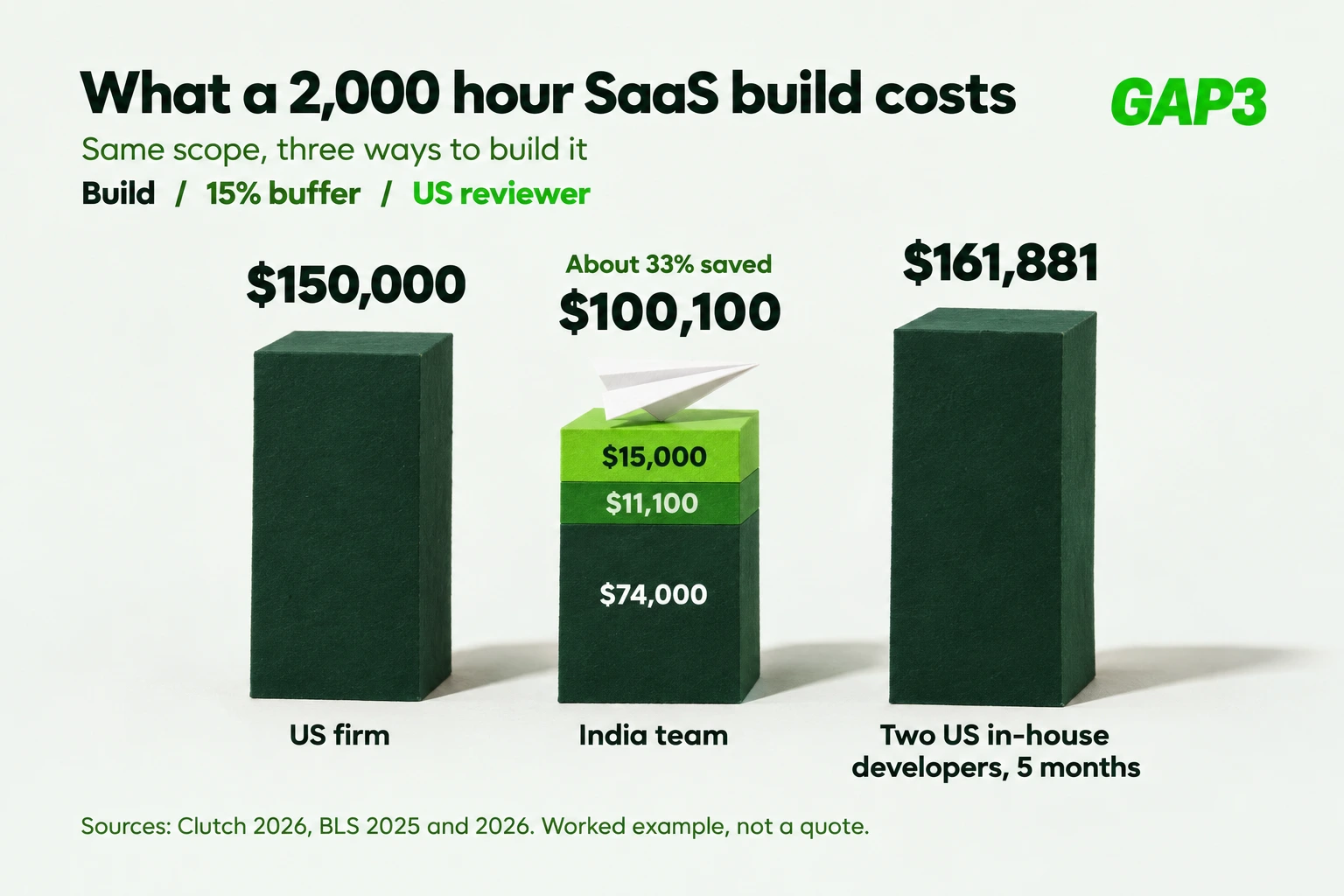
Step 1. Go with a US firm at $75 an hour and you’re looking at 2,000 x $75, which is $150,000.
Step 2. Same hours, Indian team, $37 an hour. 2,000 x $37 comes to $74,000.
Step 3. Now be honest about friction. We’d pad that by 15% for rework and the extra back and forth, so $74,000 x 0.15 = $11,100 more. You’re at $85,100.
Step 4. Maybe you want a US engineer checking the work now and then, say 100 hours at $150. That’s another $15,000, and the India route lands at $100,100.
So they save $49,900, about 33%. Skip the reviewer and it’s $64,900, about 43%. For contrast, two median US developers for five months cost about $161,881 fully loaded, and that buys no designer, no QA and no project manager.
Is 33% worth it? For a pre revenue startup, $49,900 can mean four or five extra months of runway. For a Series B company with a platform team already in place, the answer might be no, and we’d say so.
Our planning rule of thumb is 30% to 45%. Anyone promising 70% is either comparing against Bay Area salaries or leaving out the buffer. Or both.
Four ways to outsource SaaS work
Pick the model before you compare quotes. A fixed price quote and a monthly team rate look like different planets even when the underlying hours are close.
| Model | How you pay | Best for | Watch out for |
|---|---|---|---|
| Fixed scope project | A fixed, itemized price per phase | An MVP or version 1 with a clear feature list | Change requests if the scope was vague |
| Dedicated product team | A monthly fee for named people | Post launch roadmaps and steady feature work | Paying for idle weeks when your backlog is thin |
| Staff augmentation | Hourly or monthly per developer | Adding hands to an existing in-house team | You carry all the management and QA |
| Hybrid | US product lead plus an Indian build team | Funded startups that want speed and control | The US lead becomes a bottleneck if overloaded |
For a first build, we usually push for a fixed scope project split into phases. Discovery first, then the MVP, then whatever the first 50 users tell you to build. You get a price you can plan around. After launch, a small dedicated team tends to make more sense, because nobody can write a fixed spec for “whatever users ask for next month.”
Staff augmentation only works if you already have a technical lead who can hand out work and review it. Without one, you’re just renting developers and hoping. Our longer piece on how to hire SaaS developers compares freelancers, agencies and in-house hires in more detail.
A build process that holds up across time zones
When offshore SaaS projects fail, it’s rarely the code. It’s the process. Nobody wrote down what “done” meant, demos happened once a quarter, and the founder saw the product for the first time three weeks before launch. This is the sequence we’d want from any team, including ours.
- Write a one page brief. The problem, who the users are, the three workflows that must work on day one, any integrations, a deadline and a budget band.
- Pay for discovery. Two to three weeks for user flows, a clickable prototype, a data model and a written scope with acceptance criteria for every feature.
- Get a fixed, itemized quote for the first phase. Every line should map to something in the scope.
- Open the accounts in your name before any code is written: the code repository, cloud hosting, domain, payments and email service.
- Run two week sprints with a demo every week on a staging site you can click through yourself.
- Test the core flows automatically, then do a manual pass on sign up, billing, permissions and password reset. Those four break most often.
- Launch, then keep the team on for 30 to 60 days of fixes and tuning, and get written handover notes before anyone rolls off.
At GAP3 we run projects this way because it’s the only way we’ve found that works for a client 10 hours behind. Every project starts with a written scope and a fixed, itemized quote. You see a demo every week. The same senior people who scope the product also build it, so nothing gets lost between a sales team and a delivery team. Our SaaS product development page walks through what each phase includes.
Want a scope and a fixed price before you commit?
Tell us what the product needs to do and who it’s for. You get a written scope, an itemized quote in US dollars and a call slot in your morning, EST or PST.
Time zones: how the overlap actually works
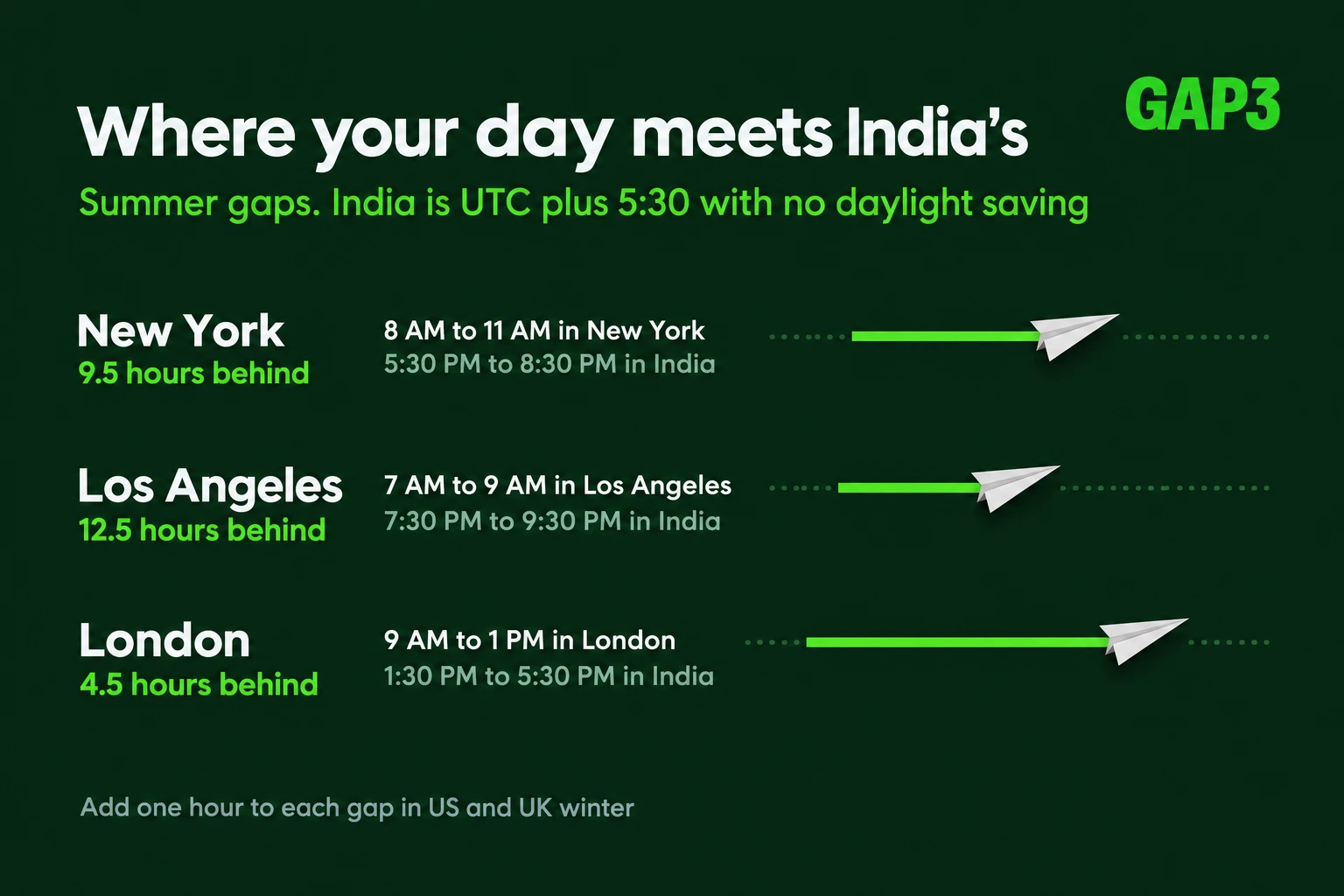
India Standard Time is UTC plus 5:30 and India doesn’t use daylight saving. So the gap moves twice a year on your side, not ours. New York sits 9.5 hours behind India in summer and 10.5 in winter. Los Angeles is 12.5 or 13.5 hours behind. London is only 4.5 or 5.5, which is why UK founders often find this setup easier than Americans do.
A New York founder takes calls from 8 AM to 11 AM, which is 5:30 PM to 8:30 PM in India in summer. A founder in Los Angeles gets a thinner window, around 7 AM to 9 AM, which is 7:30 PM to 9:30 PM for the team. In London, 9 AM to 1 PM overlaps with India’s afternoon, 1:30 PM to 5:30 PM.
The gap has an upside people oversell and a downside people ignore. Sure, you report a bug before dinner and it’s often fixed by breakfast. The flip side stings more. Send a fuzzy question and you lose a whole day, since by the time you reply, everyone over there has gone home. The fix is boring. Write tickets with screenshots and acceptance criteria, keep one shared board, and use the overlap window for decisions, not status updates.
The real risks, and how to control each one
Outsourcing risk mostly comes down to control. Who holds the code, who holds the accounts, who knows how the system works, and what happens if the relationship ends badly. Every one of these can be handled up front.
| Risk | What it looks like | How to control it |
|---|---|---|
| Code and IP ownership | The vendor keeps the repository until the final invoice | A written IP assignment in the contract and a repository in your own account from day one |
| Account lock in | Hosting, domain or payment accounts opened in the vendor’s name | You create every account and invite the team as users |
| Scope drift | Features grow, the deadline slips, change requests pile up | Written acceptance criteria and a change log with a price on every change |
| One person knows everything | Your lead developer leaves and nobody can deploy | Setup docs, a deploy script and at least two people who have shipped to production |
| Security gaps | Shared passwords, production data on laptops | A password manager, role based access and test data instead of real customer records |
| Quality you can’t see | It works in the demo and breaks with 50 users | Automated tests on core flows and a staging site that mirrors production |
Data protection deserves its own line. Selling to people in the UK or EU? Then UK GDPR or GDPR covers their personal data no matter where your developers sit. India has its own law now too, the Digital Personal Data Protection Act, 2023. The cheapest fix happens to be the best one. Give developers fake test data, and keep production access to yourself or one person you name. For contracts, have a lawyer in your own country read the IP and data sections.
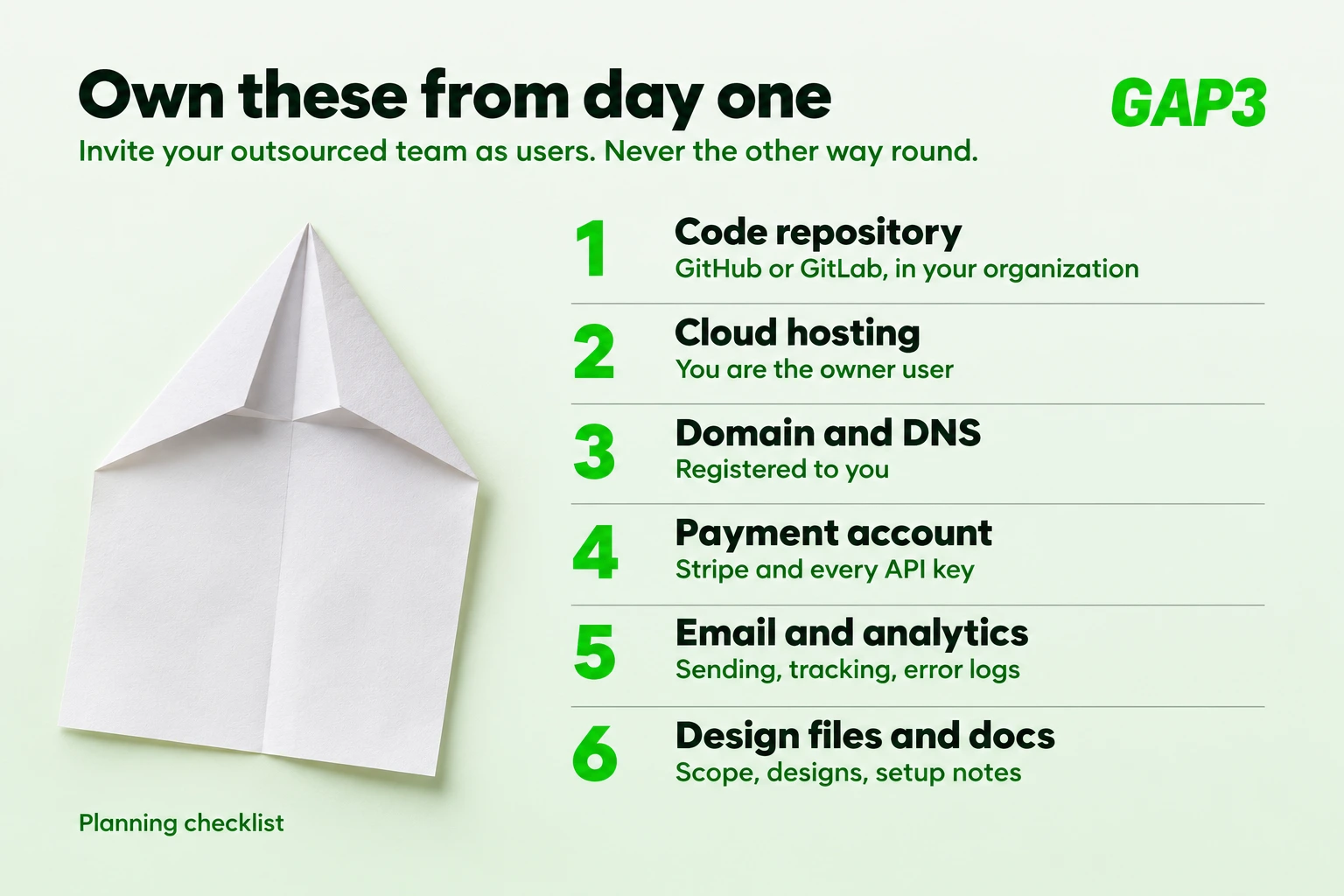
What you should own from day one
Keep every item below in your name. If a vendor pushes back on any of it, that tells you something.
- The code repository, in a GitHub or GitLab organization you created.
- The cloud hosting account, with you as the root or owner user.
- The domain name and DNS settings.
- The payment account, for example Stripe, and every API key tied to it.
- Email sending, analytics and error tracking accounts.
- Design files, the written scope and all technical docs, in a shared drive you control.
None of this slows a good team down. They just ask for access. A team that wants these things in its own name usually wants a bargaining chip later, and you don’t want to find that out during a price negotiation. Our guide to hiring a WordPress developer from India covers the same ownership points for website work.
Red flags when you vet an Indian SaaS partner
India has thousands of software firms, and the good ones and the bad ones can look identical on a sales call. Here’s what we’d watch for.
- A full quote comes back within a day, with no questions asked. Nobody can price a SaaS product from a paragraph.
- You can’t talk to the developers who would build it, only to a salesperson.
- Senior full stack developers offered at well under $20 an hour. Somebody is cutting a corner, usually testing.
- No staging site, no automated tests, and “we test manually” as the whole QA plan.
- They say yes to every feature and every date. A good team argues with you a little.
- Demos only at the end of each milestone, never weekly.
- They can’t show you a live SaaS product they built and still maintain.
Ask for a login to a staging copy of something real, not a slide. You can browse our recent projects to see how we present ours, and if you’re weighing a specialist first, our explainer on what SaaS consulting is helps with that call.
When outsourcing to India makes sense, and when it doesn’t
It makes sense when you know roughly what you’re building, you or a cofounder can give the project four to six hours a week, and your budget is realistic for the scope. It also works well for B2B tools built on common stacks. Think dashboards, portals, scheduling, billing, internal tools and integrations. Our note on why React and Next.js suit SaaS covers the kind of stack we mean.
And when shouldn’t you? Plenty of cases.
- Nobody on your side has time. An unanswered question every day will cost more than the rate saves.
- The idea is still fuzzy. Do discovery first, or talk to 20 potential users. Code is an expensive way to find out what you want.
- Your buyers require US only access to data or systems, which some government and defense contracts do. Check before you sign anything.
- The core technology is your whole moat, like a novel algorithm investors expect an in-house team to own. Outsource the admin panel, not the secret sauce.
- Your total budget is under about $15,000 for a full product. A no code tool or a narrower first version will serve you better.
If a vendor never tells you any of this, be suspicious. We’d rather lose a project at the quote stage than win one that’s set up to fail.
How GAP3 handles SaaS builds for US and UK founders
We’re based in Ahmedabad and have been at this for more than nine years, with more than 140 projects delivered and a 5.0 rating from over 40 Google reviews. US clients are billed in dollars. Calls happen in a daily window that overlaps EST and PST mornings, and UK clients get most of their working day. Every build starts with a written scope and a fixed, itemized quote, you see a demo every week, and you own every account from the first day.
Our custom SaaS application development page covers what we build and how, and our areas we serve page explains how we work with clients abroad. If you want the full picture of a custom build first, start with our custom SaaS development guide.
Frequently asked questions
How much does it cost to outsource SaaS development to India?
Clutch puts most Indian firms somewhere in the $25 to $49 an hour band. Take $37 as a middle and a lean MVP (800 to 1,200 hours) works out to roughly $29,600 to $44,400. A full version 1 is more like $74,000 to $111,000. We’d tack on another 10% to 15% for rework and back and forth.
Is outsourcing SaaS work to India safe?
It’s as safe as your contract and your setup. Put the repo, hosting, domain and payment accounts in your own name. Get the IP assignment in writing. And don’t hand real customer records to developers when test data does the job. Most offshore horror stories skipped at least one of those.
How long does it take to build a SaaS MVP with an Indian team?
Discovery is two or three weeks. After that, a lean MVP in the 800 to 1,200 hour range usually needs two to four months with three people on it. Honestly, the slowest part is often the founder’s inbox, not the code.
Should I choose a fixed price project or a dedicated team?
For a first build with a clear scope, a fixed price project split into phases gives you a number to plan around. After launch, a small dedicated team fits better, because the roadmap changes every few weeks and fixed specs stop making sense.
How do US founders deal with the time difference?
Pick a daily overlap window and protect it. For the East Coast that’s usually your morning, which is India’s evening. Write tickets clearly with screenshots, so a question doesn’t eat a full day waiting for an answer.
Will I own the source code?
You should, and the contract should say so in writing. The easy test is where the code lives. If the repository sits in an account you created from day one, ownership is never a question. Plenty of “outsource SaaS development India” quotes never mention this, so ask.
Does this work the same way for UK companies?
Mostly, yes, and you get the easier time zone. London sits just 4.5 or 5.5 hours behind India, which leaves you most of a working day together. Your customers’ data is still under UK GDPR wherever the developers are, so be stingy with production access.
Ready to find out what your SaaS will really cost?
Share your idea, your must have features and your timeline. We reply within one business day, and the quote comes fixed and itemized, in US dollars.
Gaurav Gajjar is the founder of GAP3 Studio in Ahmedabad, India. He has built websites since 2015, at Vibidsoft and Myriad Solutionz and then as a Senior Web Designer at E2M, before starting GAP3 in July 2025. With his team he has delivered more than 140 projects on WordPress, WooCommerce, Shopify and Webflow, and he built WBIZ and MyToolStudio. He writes about WordPress, ecommerce and technical SEO. Connect with Gaurav Gajjar on LinkedIn.