
Hire a Dedicated WordPress Developer from India: Guide for US Businesses


SHORT ANSWER
Think of it as renting one developer in India who only touches your sites, month to month, for roughly 160 hours. Upwork’s numbers say $15 to $28 an hour for most WordPress people, or near $2,400 to $4,480 a month, and agencies charge a little more. A US developer on the BLS median wage costs about $11,000 a month with benefits. The catch is a 9.5 to 13.5 hour time gap.
Maybe you typed something like “hire WordPress developer India for USA” into Google at 11 PM, after your only developer gave notice. Or you run a small US agency and the WordPress tickets keep piling up faster than your team can close them. Either way, you’ve probably seen the same thing we have: a wall of vendor pages promising “top 1% talent” and telling you almost nothing about how the arrangement actually works day to day.
This guide covers that part. How the engagement models differ, what a month really costs next to a US hire, how the time difference plays out in practice, which contract clauses protect you, and what the first 30 days should look like. If you want pure cost numbers, we already broke those down in our post on WordPress developer cost in the USA vs India. Here we’re talking about the working relationship.
One thing up front. We are GAP3, a web and digital marketing agency in Ahmedabad, and US businesses hire our developers. So yes, we have a stake in this. We’ll still tell you when hiring from India is the wrong move, because a bad fit costs everyone.
Want to talk to the developer, not a salesperson?
Tell us about your sites and your backlog. We’ll set up a call with the developer who would actually do the work, and reply within one business day.
What a dedicated WordPress developer actually is
The word “dedicated” gets stretched a lot. In plain terms, a dedicated developer is one named person who works on your projects and nobody else’s for an agreed block of hours each month. They join your Slack or Teams, pick up tickets from your board, and build up knowledge of your sites over time. You’re not buying a project. You’re renting a slice of someone’s working life.
That’s different from a freelancer who fits you in between four other clients, and different from a project team that builds one site and moves on. The value of a dedicated setup is memory. Month three is faster than month one because the developer already knows where your custom post types live, which plugin breaks on every update, and why the checkout page has that odd redirect.
WordPress runs 40.2% of all websites, according to W3Techs, so the talent pool is huge in both countries. Finding someone who can code isn’t the hard part. Finding someone who sticks around, communicates clearly across a 10 hour gap and treats your sites like they matter is the hard part.
Hire WordPress developer India for USA: the four engagement models
Pick the model before you compare rates. Plenty of bad offshore stories start with a full time contract for a site that needed ten hours a month.
| Model | Typical hours | Best for | Watch out for |
|---|---|---|---|
| Full time dedicated | About 160 to 170 hours a month | Agencies with steady client work, busy WooCommerce stores, ongoing product sites | Paying for idle hours if your ticket flow is thin |
| Part time dedicated | About 80 hours a month | One or two business sites with regular updates and small features | Split attention if the developer’s other half goes to another client |
| Hourly block | 10 to 40 hours, prepaid | Maintenance, small fixes, occasional landing pages | Hours expiring unused, or slow pickup because you’re not a priority |
| Fixed price project | Scoped per build | A new site, a redesign, a migration | Scope creep billed as change requests |
A quick way to choose: look at your last three months of WordPress requests. Did real work top about 100 hours a month? Then full time pays off. Sitting at 40 to 100 hours, we’d go part time. Below 40, honestly, an hourly block or a maintenance plan costs less and you’ll have fewer headaches. And if you just need one site built, skip the dedicated model entirely and get a fixed quote for custom WordPress website development.
US agencies are a special case. Many of them want a developer who works under their brand, never talks to the end client and follows their process. That’s usually called white label, and it’s how a lot of small agencies grow without hiring. If that’s you, our white label WordPress development page explains how that setup works.
What a dedicated developer costs next to a US hire
The Bureau of Labor Statistics puts the median US web developer wage at $92,650 a year as of May 2025. That’s just salary. Its employer cost survey for June 2026 shows wages are 70.0% of what private employers spend on a worker, and benefits are the other 30.0%. So the real cost of that median developer is closer to $132,000 a year.
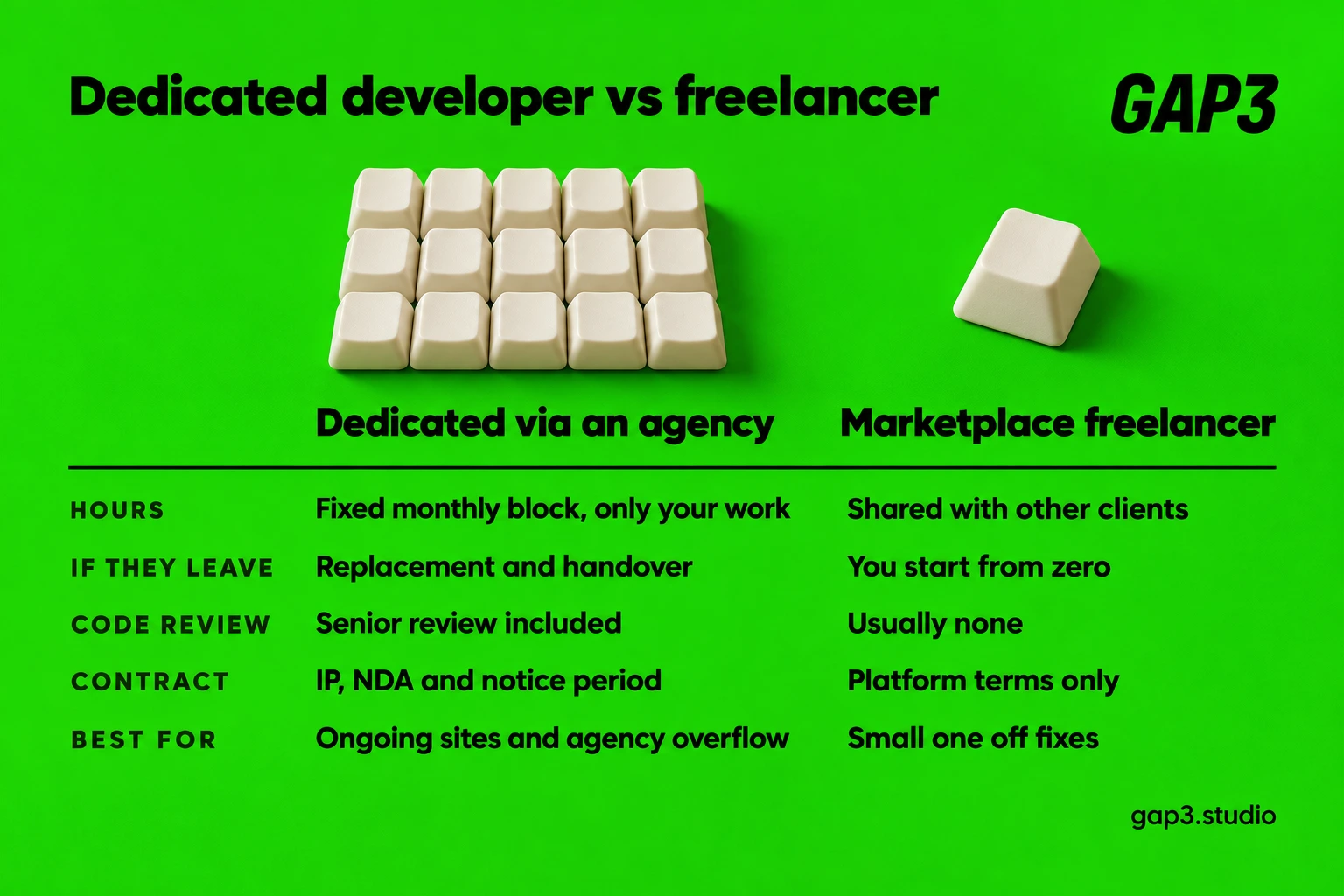
On the offshore side, Upwork’s rate guide says most WordPress developers on the platform charge $15 to $28 an hour, with a median of $20. That figure covers freelancers worldwide, India included, but it’s a fair anchor. A dedicated developer placed through an agency usually costs a little more per hour than a solo freelancer, because you’re also paying for a replacement if they leave, code review and someone senior who answers when things break.
| Option | How the monthly number is built | Monthly cost |
|---|---|---|
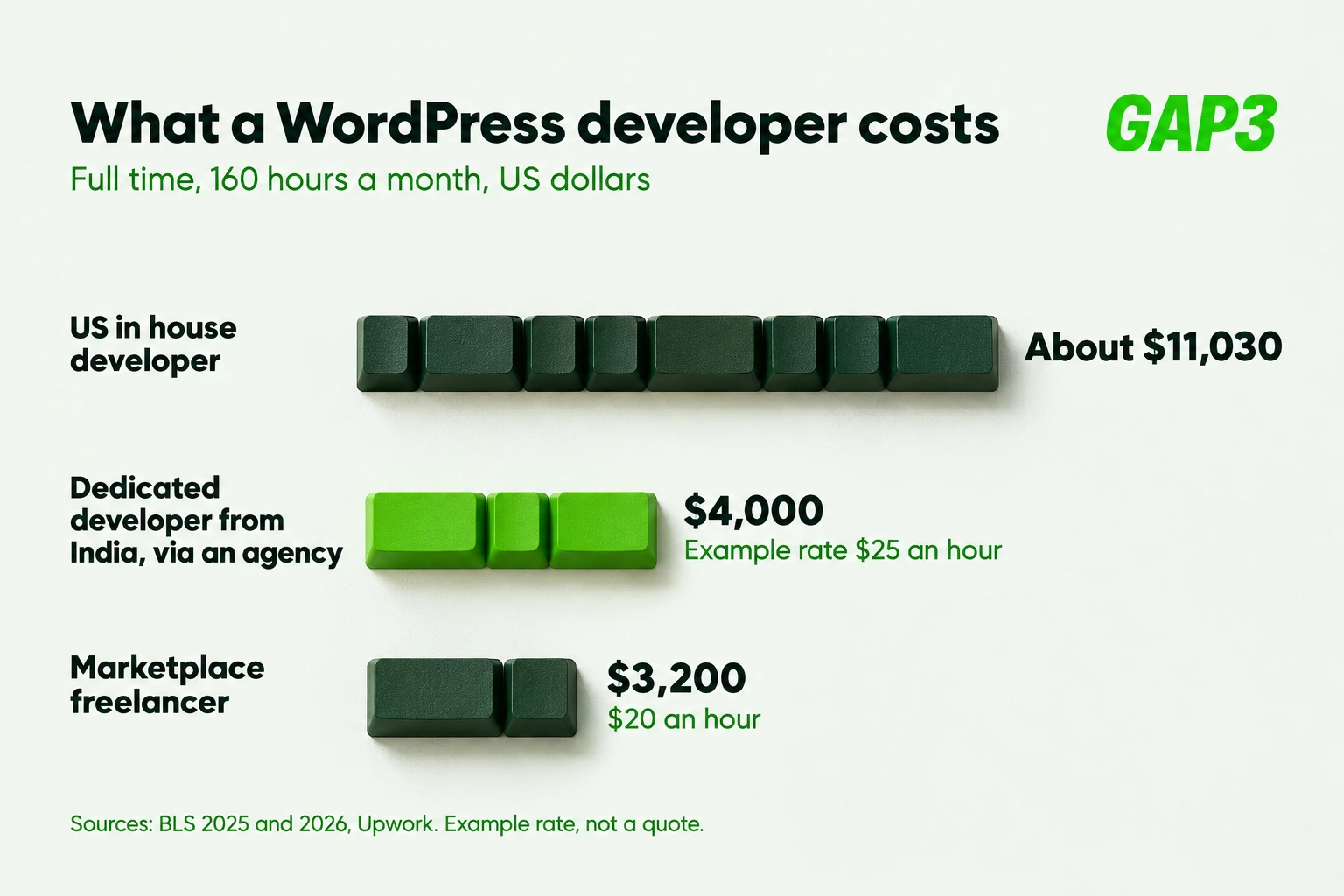
| US in house developer | $92,650 median wage divided by 0.70 to add benefits, then divided by 12 | About $11,030 |
| Dedicated developer from India, via an agency | 160 hours at an example rate of $25 an hour | $4,000 |
| Marketplace freelancer | 160 hours at Upwork’s $20 median, if one person will commit that many hours | $3,200 |
The $25 rate is an example for planning, not a quote. Sources: BLS Occupational Outlook Handbook (May 2025 wages), BLS Employer Costs for Employee Compensation (June 2026), Upwork WordPress developer rates.
WORKED EXAMPLE: A 6 PERSON AGENCY IN DENVER
Say you run a small agency with 14 WordPress client sites on care plans. Your ticket log shows about 130 hours of development a month, and your one in house developer is buried.
Step 1. Pick the model. 130 hours is steady and fairly predictable, so a full time dedicated developer at 160 hours fits, with about 30 hours left over for small builds.
Step 2. Put a number on it. We’ll use $25 an hour as an example rate. Times 160 hours, that’s $4,000 a month and $48,000 over a year.
Step 3. Now the local hire. Take the $92,650 median and divide by 0.70 so benefits are in there too. You get about $132,357 a year, so call it $11,030 a month.
Step 4. Be honest about ramp up. Assume month one runs at half speed while the developer learns 14 different sites. You still pay $4,000 for about 80 useful hours, so that month really costs $50 an hour. From month two it drops back to $25.
Year one comes out around $48,000 against $132,357 for the local hire. That’s a gap of about $84,000, before you count the time you spend writing tickets and reviewing work, which is real and shouldn’t be ignored.
Making the time difference work for you
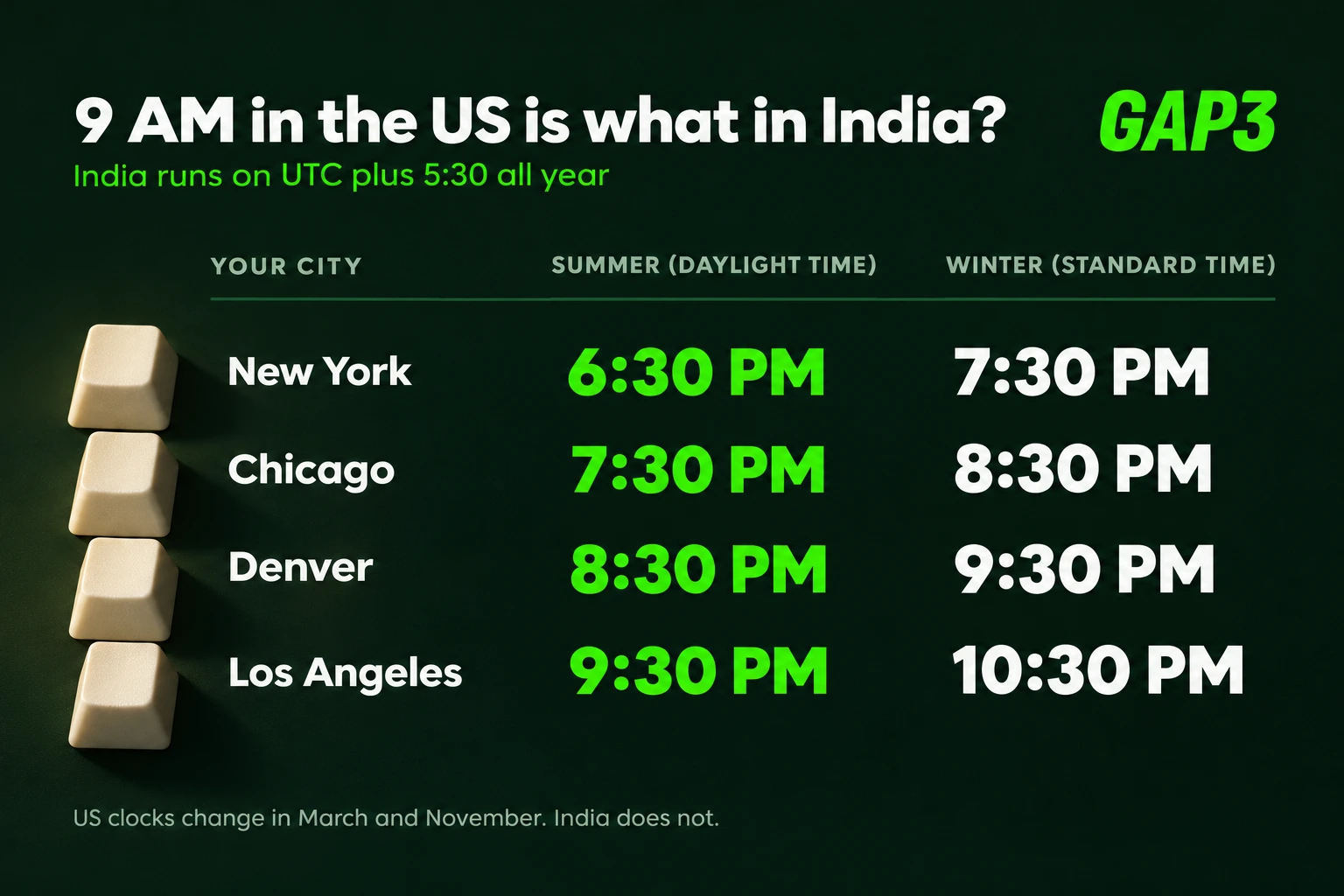
India runs on IST, which is UTC plus 5:30 all year. The US moves its clocks and India doesn’t, so the gap changes twice a year. On the East Coast in summer, you’re 9.5 hours behind India. In winter it’s 10.5. Los Angeles in winter sits 13.5 hours behind. Here’s what 9 AM in your office looks like in India.
| Your city | 9 AM in summer (daylight time) is | 9 AM in winter (standard time) is |
|---|---|---|
| New York, Miami, Atlanta | 6:30 PM in India | 7:30 PM in India |
| Chicago, Dallas, Houston | 7:30 PM in India | 8:30 PM in India |
| Denver, Salt Lake City | 8:30 PM in India | 9:30 PM in India |
| Los Angeles, Seattle, San Francisco | 9:30 PM in India | 10:30 PM in India |
Two setups work in real life. The first is a shifted day: the developer starts around 1 PM or 2 PM India time and stays into the evening, which gives you two to four hours of live overlap in your morning. The second is a handoff: you write tickets during your day, the developer builds while you sleep, and you wake up to a staging link with the work done. Most good setups mix both: a short call in your morning, then async for the rest.
The handoff model is honestly underrated. A bug you log at 4 PM in Chicago can be fixed and waiting on staging by 8 AM. What doesn’t work is expecting instant replies at 3 PM Pacific. That’s 3:30 AM in Ahmedabad in summer. Nobody good is awake then, and you shouldn’t want them to be.
Put the clock change dates in both calendars. US daylight time ends on the first Sunday in November and starts on the second Sunday in March. After each switch, your standing call moves an hour for one side, and someone always misses the first one.
Contracts, IP and paperwork for US companies
This is the part vendor pages skip, and it’s where offshore deals actually go wrong. You don’t need a 40 page contract. You do need these things in writing before any code is written.
- IP assignment. The contract should say that all code, designs and content made for you are assigned to you once paid. Ask your lawyer about this one, because “work made for hire” wording on its own doesn’t always cover work by an outside contractor under US copyright law.
- Confidentiality. A simple NDA covering your business data, your clients’ data and any login details the developer sees.
- Replacement terms. If your developer leaves or gets sick for weeks, how fast does the agency put someone new on your account, and who pays for the handover time?
- Notice period. Thirty days either way is normal. Anything that locks you in for a year before you’ve seen a month of work is a bad sign.
- Payment terms. Currency, invoice dates, and how you pay. Paying in US dollars by wire or card keeps your books simple.
- Tax forms. A foreign contractor usually gives you a Form W-8BEN, or a W-8BEN-E if it’s a company, instead of the W-9 you’d get from a US contractor. The IRS page on Form W-8BEN explains who files it. Run your own setup past your CPA.
Also decide who owns the accounts. Your domain, hosting, Git repository and WordPress admin should all sit under your name, with the developer invited as a user. If the relationship ends, you remove one login and nothing else changes.
How to vet a developer before you commit
We covered general interview questions in our guide on how to hire a WordPress developer in 2026. For a dedicated offshore hire, add three checks.
Meet the actual developer
Not the account manager. Not the founder. The person who will open your code every morning. Thirty minutes on a site they built tells you more about their English and their honesty than any portfolio.
Run a paid test task on a staging copy
Pick something real and small, maybe four to six hours of work. A broken WooCommerce shipping rule, a slow template, a form that doesn’t send. Pay for it. Then look at how they worked, not just the result. Did they ask questions first? Did they use Git? Did they explain what they changed? If you run a store, a test around checkout tells you a lot about whether they know WooCommerce development beyond installing plugins.
Ask for a sample daily update
Sounds minor. It isn’t. In a 10 hour time gap, the written end of day update is the relationship. Ask them to write one for the test task. Three or four clear lines: what got done, what’s blocked, what’s next. If that note is vague, every note after it will be too.
See how a dedicated setup would work for your sites
Share your sites, your monthly workload and your time zone. We’ll suggest a model, send a fixed itemized quote in US dollars, and set up a call with the developer.
The first 30 days with your new developer
Most offshore setups that fail do it in month one, usually because nobody planned it. Here’s the plan we’d suggest, whoever you hire.
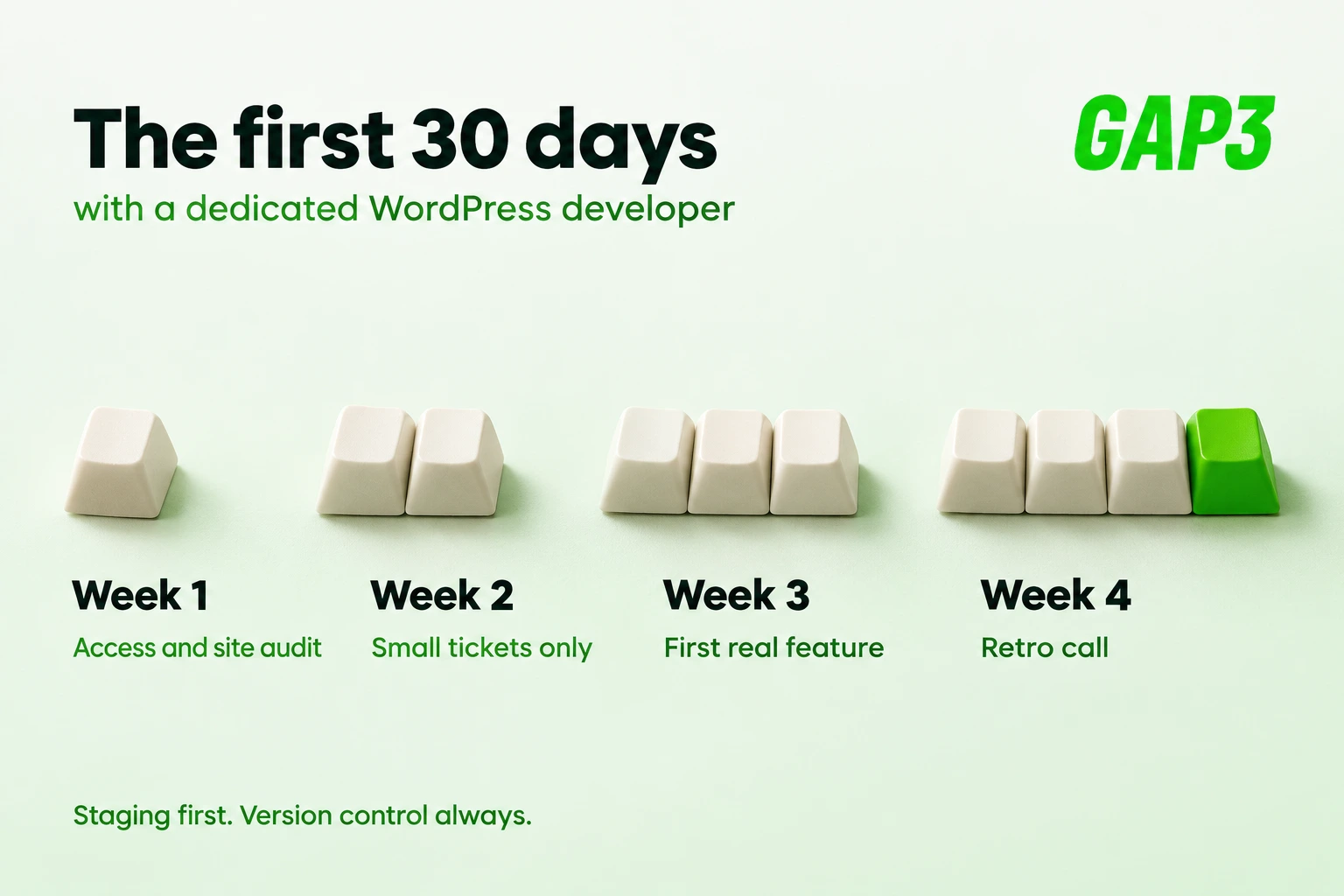
- Week 1, access and a site audit. Give the developer their own WordPress admin account, SFTP or SSH access, and a seat in your password manager. Never share your personal login. Ask for a written audit of each site: plugins, PHP version, hosting, backups, anything that looks fragile.
- Week 2, small tickets only. Content updates, a plugin conflict, a styling fix. You’re testing the loop (ticket, staging, review, release), not their skill.
- Week 3, the first real feature. Something that takes a few days and touches custom code. Review it properly before it goes live.
- Week 4, a short retro call. What was slow, what was unclear, which tickets bounced back. Fix the process now, while it’s cheap.
Two rules help a lot. Every change goes through a staging site first, and every change goes into version control. That way you can see who changed what, and roll it back in minutes when a plugin update goes sideways.
Red flags when hiring offshore
- You can’t meet the developer before signing, only a sales rep.
- They want your main admin password or your hosting root login in week one.
- No staging site, no Git, and they’re happy to edit the live site directly.
- The rate is far below the market, like $8 an hour for a “senior” developer. Someone is cutting a corner somewhere, and it’s usually testing.
- No replacement clause. If your developer quits, you start from zero.
- Silence for two days, then a big batch of changes with no notes.
- The contract says the agency owns the code until some future condition is met.
If you’re still unsure whether you want one person or a team behind that person, our breakdown of a WordPress development company vs a freelancer goes through that trade off in detail.
When hiring a dedicated developer from India is the wrong call
Sometimes it just doesn’t fit.
If your site needs ten hours of work a month, a dedicated contract is overkill. A website maintenance plan or an hourly block will cost far less. If nobody on your side has time to write tickets and review work, an offshore developer won’t fix that. Somebody has to own the backlog, and it can’t be the person 8,000 miles away.
It’s also the wrong call if you need someone in the room, like a developer who sits in on sales meetings with your clients in Boston, or if your contracts with healthcare or government clients require US based staff to touch the data. Read those clauses first. And if your store needs a person on call at 2 PM Pacific every day for live fixes, you’ll either need a late night shift in India, which costs more and burns people out, or a US developer for that slot.
Where India works really well is steady execution work. Care plans, WooCommerce stores, custom themes and plugins, speed fixes, landing pages, and overflow for agencies. That’s most WordPress work, to be fair.
How we run dedicated WordPress work for US clients
Since we’re the ones writing this, here’s how we set it up at GAP3. US clients are billed in dollars. Calls happen in a daily window that lands in your morning, whether you’re on Eastern or Pacific time. Project work starts with a written scope and a fixed, itemized quote, and you see a demo every week. We reply within one business day. The senior people who scope the work are the same people who build it, so nothing gets lost in a handoff between sales and delivery.
We’ve delivered more than 140 projects over nine years and hold a 5.0 rating from more than 40 Google reviews. You can browse recent work or see the details of how you can hire a dedicated WordPress developer from us month to month.
Frequently asked questions
So what does a dedicated WordPress developer from India cost me?
On Upwork, most WordPress developers sit at $15 to $28 an hour. Over a 160 hour month that’s somewhere near $2,400 to $4,480. Agencies usually charge a bit more because they cover replacements, code review and senior backup. A US developer on the BLS median wage costs about $11,000 a month once benefits are added.
Can my US company legally work with a developer in India?
Sure. We see it every week. The usual setup is a contractor deal, signed with the developer directly or with their agency, so you never put them on your payroll. Just make sure there’s a real contract with IP assignment and an NDA in it, and have your CPA look at the tax side once.
Does a developer in India need a 1099 from me?
Usually not. Instead of a W-9, you’d ask them for a W-8BEN (or the W-8BEN-E version if you’re paying their company). Your own setup might change things, though, so we’d run it past your accountant before the first invoice gets paid.
How many hours of overlap will I get with a developer in India?
With a shifted schedule that starts around 1 PM or 2 PM India time, East Coast clients usually get two to four hours of live overlap in their morning. West Coast overlap is shorter, so plan a short morning call and handle the rest in writing.
Who owns the code a dedicated developer writes?
You should, as soon as it’s paid for. Put an IP assignment clause in the contract and keep your domain, hosting, Git repository and WordPress admin in your own name from day one.
Should I hire a full time or part time dedicated developer?
Look at your last three months of requests. Over roughly 100 hours of real work a month points to full time. Between 40 and 100 suits part time. Under 40 is usually cheaper as an hourly block or a maintenance plan.
How long before a new developer is fully productive?
Month one is always slower. They’re learning your sites, your odd plugins, how you like tickets written. Give them the audit week, keep week two boring on purpose, and do the retro. In our experience that cuts the slow patch down a lot.
Ready to meet your WordPress developer?
Tell us your sites, your workload and your time zone. We’ll reply within one business day with a suggested setup, a fixed quote in US dollars and a time to talk to the developer.
Gaurav Gajjar is the founder of GAP3 Studio in Ahmedabad, India. He has built websites since 2015, at Vibidsoft and Myriad Solutionz and then as a Senior Web Designer at E2M, before starting GAP3 in July 2025. With his team he has delivered more than 140 projects on WordPress, WooCommerce, Shopify and Webflow, and he built WBIZ and MyToolStudio. He writes about WordPress, ecommerce and technical SEO. Connect with Gaurav Gajjar on LinkedIn.