
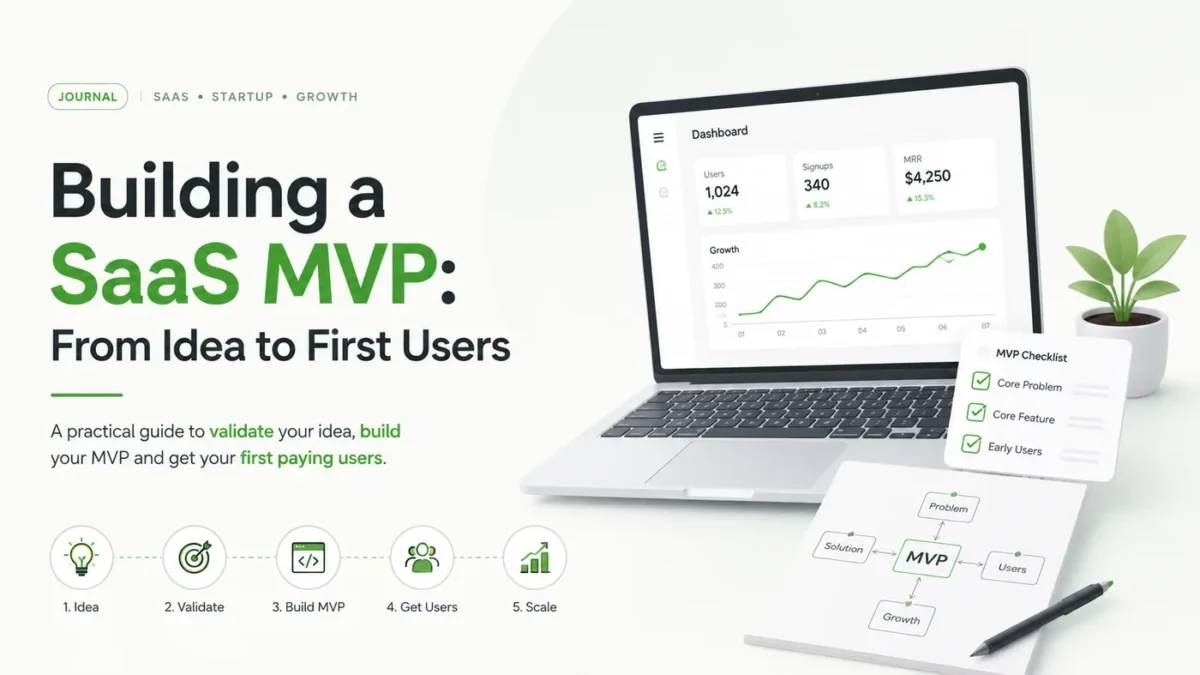
An MVP is not a smaller version of your dream product. It is the quickest real test of whether anyone wants the thing at all. Most first time founders build too much, launch too late, and learn the same lesson they could have learned in half the time. Here is how to build a SaaS MVP that answers the only question that matters early: will people use this and pay for it.
What an MVP is
MVP stands for minimum viable product. The useful word is viable. It has to work well enough that a real person gets real value from it. A broken toy is not an MVP. A single feature done properly can be.
The mistake runs in both directions. Some people ship something so thin it embarrasses them and teaches nothing. Others polish for a year and call the bloated result an MVP because they are scared to launch. The target sits between those. One clear job, done well enough that someone would miss it if you took it away.
Start with the problem before the features
Founders love feature lists. Users do not care about your features. They care about a problem they have right now that hurts enough to pay to remove.
Before any code, get specific about that problem. Work out who has it and how they solve it today, even if the current fix is a messy spreadsheet and a lot of copy and paste. Then put a number on what that workaround costs them in hours and money. If you cannot describe the problem in two plain sentences, you are not ready to build. You are ready to go talk to more people.
We have watched teams skip this and build a beautiful product for a problem that turned out to be mild. The code was fine. The premise was wrong, and no amount of clean code fixes a wrong premise.
Cutting scope to something you can ship
This is the hardest part of custom SaaS development, and it is not technical. It is the discipline to leave things out.
Take every feature you imagine and sort it hard:
- Core. Without this, the product does nothing useful. This is your MVP, and it should be a short list.
- Soon. Real value, but the product works without it for now. This waits.
- Someday. Nice ideas that feel important because they are yours. Most never get built, and that is fine.
Be ruthless with the core list. If sign up, one workflow, and a way to pay cover the promise, that is your build. Reporting dashboards, team permissions, integrations, fancy onboarding flows almost always belong in Soon, no matter how much they call to you.
A quick test for any feature
Ask one thing. If this feature did not exist on launch day, would a user still get value and still pay? If yes, it is not core. That single question settles most arguments about scope faster than a long meeting ever will.
Building the MVP without overbuilding
Once scope is set, the build should move quickly. This is where the right saas application development services save you months, because you reuse proven patterns instead of inventing plumbing from nothing.
A few principles keep an MVP fast to build and cheap to change:
- Use boring, known tools. React and Next.js for the interface, one database, a payment processor for billing. Save your creativity for the product and keep the stack plain.
- Do not build what you can rent. Authentication, email delivery, payment handling, file storage. These are solved problems. Wire in services and move on.
- Keep the data model simple, but not so simple that you paint yourself into a corner on tenancy. Get that one piece right from the start.
- Write only the admin tools you need to support the first users. No more.
An MVP that takes eight months is usually not an MVP. It is a full product wearing the wrong label. Aim to have something real users can touch inside a few months.
Getting your first users
Launching to silence is the quiet fear behind every build. You avoid it by lining up users while the product is still being built.
Go back to the people whose problem you described earlier. They are your first users. Let a handful in while the product is still rough and watch them use it without your help. The urge to jump in and explain is strong. Resist it, because the moment they get stuck is the most useful data you will get all month.
Charge money sooner than feels comfortable. A free user tells you the product is pleasant. A paying user tells you it is worth something. Those are different facts, and only one of them keeps a company alive. Even a small price filters for people who feel the problem enough to pay.
What to measure once people are in
Vanity numbers feel good and mean little. Signups look great until you notice almost nobody comes back. Track the things that predict a real business:
- Activation. Do new users reach the moment where the product first helps them, or do they stall before it?
- Retention. Are they still around after a week, a month, two months?
- Willingness to pay. Do trials turn into paid accounts, or do people leave when the card is due?
Retention is the number that does not lie. A product people keep using has found something real. A product with great signups and no retention is a leaky bucket, and pouring marketing into a leaky bucket just wastes money faster.
When to rebuild and when to keep going
MVP code is meant to move fast, so it carries shortcuts. At some point the shortcuts start slowing you down, and founders panic and want to rebuild from scratch. Usually that is a mistake.
Rebuild only when the current code actively blocks the things customers are asking for, and when you have enough paying users to justify the pause. Until then, keep shipping and clean up as you go. A rewrite with no customers is just procrastination with a technical excuse. Plenty of the biggest SaaS products still run on messy early code, patched steadily over years.
Choosing a saas application development services company that builds MVPs with this in mind matters. You want work that is quick now but not so throwaway that it traps you in three months. That balance is a craft, and it is easy to get wrong in either direction.
From MVP to real product
The MVP starts the conversation with the market. It does not end your build. If it finds users who stick and pay, you expand carefully, guided by what they do rather than what you imagined. If it does not, you have learned that cheaply and can change direction with money still in the bank. When you want a team that has taken products from a blank page to first users before, see our custom SaaS application development services, or share where your idea stands through the quote form.
Gaurav Gajjar is the founder of GAP3 Studio in Ahmedabad, India. He has built websites since 2015, at Vibidsoft and Myriad Solutionz and then as a Senior Web Designer at E2M, before starting GAP3 in July 2025. With his team he has delivered more than 140 projects on WordPress, WooCommerce, Shopify and Webflow, and he built WBIZ and MyToolStudio. He writes about WordPress, ecommerce and technical SEO. Connect with Gaurav Gajjar on LinkedIn.